
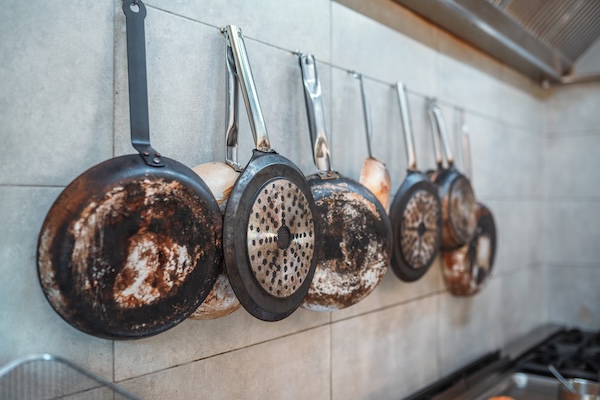
If you run a commercial kitchen, carbon buildup is something your team deals with every single day, even if they do not always call it by that name. It is the black, crusty layer that coats the bottoms of pots, bakes onto sheet pans, and turns oven racks from silver to near-black over time. It is stubborn, it is unsanitary, and left unaddressed, it affects food quality, equipment performance, and the overall cleanliness of your operation.
This guide explains what carbon buildup actually is, why it forms, what it costs you if you ignore it, and how to remove it efficiently in a commercial kitchen environment.
What Is Carbon Buildup?
Carbon buildup is the residue that forms when organic matter, primarily fats, oils, sugars, and proteins, is exposed to high heat repeatedly over time. When food particles or cooking oils contact a hot metal surface and are not fully cleaned away, they oxidize and polymerize, meaning their molecular structure changes under heat into a hard, carbonized layer that bonds to the metal surface.
The result is that dark, baked-on coating that standard dish machines and three-compartment sinks struggle to remove. Light carbon accumulates quickly on high-use equipment. Heavy carbon buildup develops over weeks or months of incomplete cleaning and can reach a thickness and hardness that makes manual scrubbing almost impossible without damaging the surface underneath.
FOG, which stands for Fat, Oil, and Grease, is the primary contributor to carbon buildup in commercial kitchens. As FOG is repeatedly heated and not fully removed between uses, it cures onto cookware and equipment surfaces in layers. Each cooking cycle adds another layer. Over time, that accumulation becomes a serious operational problem.
Why Carbon Buildup Is a Problem
The most visible consequence is cosmetic, but the actual costs run deeper than appearance.
Food quality suffers. Carbon-coated pans heat unevenly, creating hot spots that scorch food in one area while undercooking it in another. Residual carbon can also impart undesirable flavors to food, especially in high-heat applications like sauteing and roasting. For kitchens with quality standards to maintain, that is not acceptable.
Equipment wears out faster. Heavy carbon acts as an insulating layer that forces equipment to work harder to reach and maintain cooking temperatures. It also traps moisture against metal surfaces, accelerating corrosion over time. Equipment that is kept clean consistently lasts significantly longer than equipment that is allowed to accumulate buildup.
Cleaning becomes a labor drain. Staff spending time scrubbing heavily carbonized pans and trays is time that is not going toward food production, service, or anything else that moves the business forward. In a labor environment where every hour counts, this is a real cost. Many operations simply throw away heavily carbonized equipment rather than attempt to clean it, which adds direct replacement costs on top of the labor already spent.
Fire risk increases. Carbon buildup on cooking equipment and in exhaust systems is combustible. As it accumulates on hood filters, oven interiors, and cooking surfaces, it raises the fire risk in your kitchen. Keeping equipment clean is not just an operational practice, it is a safety concern.
Health inspections become harder to pass. Inspectors look at the condition of your equipment. Heavy carbon accumulation signals a cleaning program that is not keeping up with the demands of the operation, and it can result in violations that affect your score and your reputation.
Where Carbon Buildup Forms Most Often
In a commercial kitchen, carbon accumulates fastest on the surfaces that see the most direct heat and the most cooking residue.
Sheet pans and baking trays are among the most common culprits. They are used constantly, often stacked and stored before they have been fully cleaned, and they come into direct contact with sugars and fats that carbonize quickly at oven temperatures.
Pots and pans, especially those used for sauces, stocks, and high-heat saute work, accumulate carbon on their bottoms and lower sides from direct flame or burner contact. The exterior of cookware often gets less attention than the interior but builds up carbon just as quickly.
Oven racks and interiors collect drips and spills that bake on over time. In high-volume operations running ovens for long stretches, this accumulation can be significant within just a few weeks.
Hood filters and exhaust components are where carbon and grease accumulation carries the highest risk. These surfaces collect the vapors rising from every piece of cooking equipment below them. When cleaning intervals stretch too long, the buildup reaches a level that creates fire hazards and reduces the effectiveness of the ventilation system.
Fry baskets, particularly in operations with heavy fryer use, accumulate carbon and polymerized oil rapidly. A basket that has not been properly cleaned will affect oil quality and, over time, transfer undesirable flavors to the food being cooked in it.
How to Remove Carbon Buildup
The method you use to remove carbon buildup depends on how heavy the accumulation is and what equipment you are working with.
For light buildup, regular cleaning with a commercial degreaser and hot water can be effective if done consistently. GrimeGo®, the non-caustic, non-toxic all-purpose cleaner and degreaser from Hyginix, works well on floors, mats, oven interiors, and other surfaces where carbon and grease are in the early stages of accumulation. Consistent use of a product like GrimeGo® as part of your daily cleaning routine prevents light buildup from progressing to the heavy stage.
For moderate to heavy buildup, soaking is the most effective approach. Hot water and a cleaning agent that can penetrate and break down the carbonized layer allows the buildup to soften and release from the metal surface without aggressive scrubbing that risks scratching or damaging cookware. The challenge in most commercial kitchens is that traditional soaking methods, using the three-compartment sink or a separate vessel with hot water and a standard degreaser, require constant attention. The water cools, needs to be replaced, and the chemical is spent after a single use.
The FOG Tank® was designed specifically to solve this problem. It is a thermostatically controlled heated soak tank that maintains water at a consistent 185°F, using The FOG Tank's proprietary Tiger Carbon-Removal Powder. The Tiger Carbon-Removal Powder is non-caustic, non-toxic, fully biodegradable, aluminum-safe, food-safe, and completely safe for the people using it.
What makes The FOG Tank® fundamentally different from other soaking approaches is the duration of the solution. Rather than single-use water and chemicals that must be replaced after every cleaning session, the water and Tiger Carbon-Removal Powder in The FOG Tank last for a full month of continuous use, whether the tank runs once a month or 24 hours a day. That is over 340,000 gallons of water saved per year compared to traditional sink-based cleaning methods.
The process is simple. Fill the tank, add the powder, load your equipment using the included lifting basket, close the lid, and walk away. Depending on how heavy the carbon accumulation is, items can be left to soak anywhere from ten minutes to overnight. When removed, even heavily carbonized surfaces release their buildup with a simple rinse, no scrubbing required.
For hood filters, which are among the most labor-intensive items to clean in any commercial kitchen, The FOG Tank delivers results that operators have documented in concrete terms. Hood filters soaked in The FOG Tank come out measurably lighter than when they went in, which reflects how much grease and carbon has been removed. The same filters left to soak overnight in a three-compartment sink consume far more water and chemicals to achieve a lesser result.
Building a Cleaning Program That Prevents Heavy Buildup
Removing heavy carbon buildup is more time-consuming and costly than preventing it from reaching that stage. A cleaning program built around consistent intervals and the right tools keeps buildup manageable and your equipment in better condition over its full lifespan.
For high-use cookware like sheet pans, baking trays, and saute pans, regular soaking in The FOG Tank prevents the accumulation that turns a ten-minute soak into an overnight one. For hood filters, following a cleaning schedule that matches your cooking volume keeps grease and carbon from reaching the level where it becomes a fire hazard or a compliance issue.
The operational benefits extend beyond cleanliness. Equipment that is cleaned consistently performs more reliably, lasts longer, and requires less labor to maintain. Staff spend less hours on cleaning. Replacement costs for worn-out cookware decrease. Health inspections become routine rather than stressful.
If your operation is dealing with carbon buildup that has gotten ahead of your current cleaning program, or if you are looking for a better approach before it reaches that point, contact us now to speak with one of our experts or order yours today.