
A clean commercial kitchen does more than look good for any guests who may happen to see it. It protects your health inspection score, extends the lifespan of expensive equipment, keeps your team safer, and guards against one of the most costly risks a restaurant faces: a kitchen fire. The amount of labor, water, and money it takes to clean your kitchen will depend, in part, on the restaurant cleaning products you stock.
Backed by real consumers and years of experience in the field, we’ve developed this guide and organized it by the job each product does rather than by brand, so you can build a cleaning kit that matches your kitchen. Get the right restaurant cleaning products and tools for each task and the savings show up where they count, in labor hours and your monthly bills.
Table of Contents:
A Simple Way to Sort Restaurant Cleaning Products
Most commercial kitchen cleaning products fall into a few working groups:
- Cleaners lift visible soil from surfaces.
- Degreasers break down the fat and grease that build up on equipment, floors, and walls.
- Sanitizers reduce bacteria on food-contact surfaces.
- Equipment cleaning systems handle the hardest jobs, like baked-on carbon on metal cookware and kitchen gear.
Organizing your cleaning supplies according to this framework not only helps ensure you cover all your bases, but also that you always have the best restaurant cleaning products for each job.
Understanding Cleaning vs. Sanitizing
We’ve noticed one distinction trips up a lot of operators: cleaning and sanitizing are not the same step. Cleaning physically removes food and soil from a surface with detergent, water, and effort. Sanitizing comes after and reduces the bacteria left behind. You need both, and you usually need different products for each.
A Quick Note on Volume, Cost, and Value for Commercial Cleaning Products
It’s also worth noting that professional-grade cleaning products are usually sold as concentrates. While a jug costs more upfront, the cost per use often lands lower than consumer products. Plus, these cleaning supplies are formulated to meet health code standards that household cleaners are not. It’s not worth trying to go with household cleaning products instead of commercial ones.
Putting Your Restaurant Cleaning Product Kit Together
Here’s a quick way to map each job to the right restaurant cleaning product as you plan your kit, along with a few recommendations to get you started.
Cleaning Job or Zone | Product Type | What to Look For | Recommended Product(s) |
|---|---|---|---|
Baked-on carbon on pots, pans, and trays | Heated soak tank plus carbon removal powder | Non-caustic formula, holds temperature, fits your space | |
Dishes and glassware | Machine detergent and rinse aid | Compatible with your machine and water hardness | Products compatible with your machine and water hardness |
Food-contact surfaces | Chlorine, quat, or iodine sanitizer | EPA registered, correct ppm for the type | Chlorine, quat, or iodine sanitizer at the correct concentration |
Floors, mats, oven interiors, and surfaces | All-purpose degreaser | Non-toxic, works across many surfaces | |
Drains | Enzyme drain treatment | Digests organic buildup | |
Hood filters | Heated soak tank | Better cleaning, less staff labor, avoids single-use water and chemicals, supports your NFPA 96 cadence | |
Sanitizer verification | Test strips | Matched to your sanitizer type | Chlorine and/or quat strips, depending on your sanitizer |
Keep reading to learn more about each component of your commercial kitchen’s cleaning kit below.
Don’t Forget to Buy Sanitizer Test Strips
Sanitizer test strips are the cheapest product on this list and the one kitchens forget most often. They prove your sanitizer is actually at strength, which matters because concentration is the whole game. Too weak and you fail an inspection, too strong and you waste product and risk a chemical residue.
Keep strips matched to your sanitizer type, since chlorine and quat strips read differently. Hydrion strips from Micro Essential Lab are a widely used option, and most foodservice suppliers carry these or an equivalent.
Choosing the Right Food-Contact Sanitizers
Sanitizers are a category worth getting right for a commercial kitchen, and one we recommend you stock alongside your other restaurant cleaning products and gear. The FDA Food Code recognizes three chemical sanitizers for food-contact surfaces: chlorine, iodine, and quaternary ammonium (often shortened to quats). All three are regulated by the EPA and considered food-safe at the correct strength.
Concentration is what makes them work. A chlorine solution sanitizes at 50 to 100 ppm, quats at around 200 ppm, and iodine at about 25 ppm, each held for the short contact time printed on the label. If you prefer heat, the third compartment of a three-compartment sink must reach 171°F or hotter to sanitize.
One useful thing to know: chlorine handles most bacteria and viruses well but struggles to break down organic matter and biofilm. That is a reminder that you clean and degrease first, then sanitize.
Invest in a Heated Soak Tank for Metal Equipment and Hood Filters
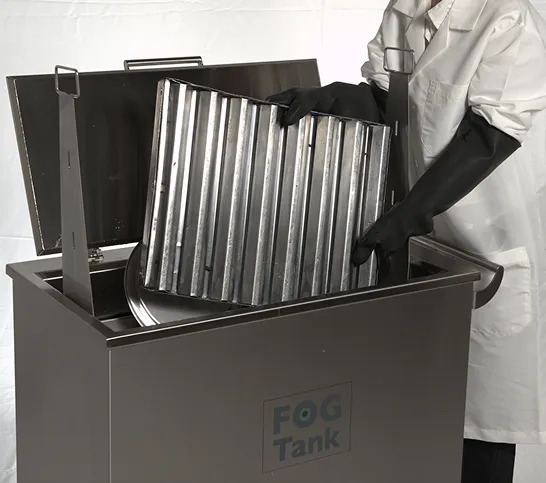
The toughest cleaning job in most kitchens is baked-on carbon and heavy grease on pots, pans, fry baskets, sheet trays, and hood filters. Hand scrubbing eats labor hours, and a dish machine usually cannot touch that kind of buildup.
This is where the FOG Tank® earns its place. It’s a heated soak tank that removes fat, oil, grease, and heavy carbon buildup from metal cookware and equipment without scrubbing. FOG stands for Fat, Oil, and Grease, which is exactly what the tank pulls off your gear. The tank holds water at a steady 185°F and is built from 304 stainless steel, so it safely cleans every type of metal, including aluminum.
The cleaning power of the tank comes from Tiger Carbon Removal Powder, a non-caustic, non-toxic, biodegradable agent that does the work while your staff does something more useful. Here’s the part operators tend to like most: the water and powder last for a full month per fill, so you aren’t draining and refilling a sink every time you clean.
A single tank can cut stewarding labor by half an hour or more each day, save over 340,000 gallons of water per year, and take up to 60% less space than a three-compartment sink. For a busy kitchen, or a multi-unit group trying to standardize cleaning across locations, that adds up quickly.
Get an All-Purpose Degreaser for the Kitchen Surfaces Around You
Once the heated soak tank handles your commercial kitchen equipment and metal cookware, you still have grease migrating onto nearby surfaces, including:
GrimeGo® is a non-caustic, non-toxic, biodegradable all-purpose cleaner and degreaser made specifically for those jobs. The advantage of having one safer formula across many surfaces is a simpler supply closet and fewer harsh chemicals for your team to handle and store. It’s also a necessary companion to your cleaning routine for anything that doesn’t fit in a heated soak tank.
A Few More Restaurant Cleaning Products That Round Out Your Kit
A handful of complementary picks cover the minor remaining gaps your soak tank, degreaser, and sanitizers leave:
- Dish machine detergent and rinse aid keep your high-temperature warewasher producing clean, spot-free plates and glassware. Match the detergent to your machine and your water hardness.
- Stainless steel cleaner or polish gives equipment exteriors the bright, streak-free finish that leaves a positive first impression on guests, investors, and inspectors. Weiman and Sprayway both make popular options a kitchen can keep on hand.
- Microfiber cloths and scour pads handle daily wiping and stubborn spots. Color-coded microfiber cloths help prevent cross-contamination, and 3M Scotch-Brite pads are a reliable scrubbing standby.
- Enzyme drain treatments digest organic buildup to keep lines flowing and odors down. Products like Bio-Clean and Green Gobbler are easy to work into a weekly routine.
None of these replaces the others. Each keeps one job covered so the rest of your cleaning kit stays focused.
A Warning About Hood Filters and Fire Safety
Hood filters deserve their own separate mention here, because they sit at the intersection of your hardest cleaning job and your biggest safety risk. Cooking equipment is involved in roughly 3 out of 5 restaurant fires, and grease buildup in the exhaust system is one of the most common preventable causes.
NFPA 96, the national standard for commercial kitchen ventilation and fire protection, is written into most local fire codes and is commonly required by insurers as a condition of coverage. It calls for listed grease filters and regular cleaning of the exhaust system. Hood filters are cleaned in a degreasing solution, rinsed, dried, and reset at the correct angle, no less than 45° from horizontal. Any filter that is bent or damaged gets replaced rather than reinstalled.
The labor trap here probably sounds familiar. Many kitchens leave hood filters soaking in a three-compartment sink, which ties up the sink and pours out water and chemicals night after night. A heated soak tank cleans those filters thoroughly without monopolizing the sink, which makes the regular cleaning cadence required by the code far easier to keep.
Start Building Your Kitchen’s Kit with Top Restaurant Cleaning Products from Hyginix
A spotless kitchen is the result of matching the right product to each job, leading with the safer non-toxic option wherever you can, and verifying your work with something as simple as a test strip. Done well, it gives you back labor hours, lowers your water and energy use, and keeps you ready for both the health inspector and the fire marshal.
Hyginix is a woman-owned, family-run business dedicated to developing cleaning solutions that combine sanitary, operational, financial, and eco-friendly benefits for commercial kitchens. Our restaurant cleaning product lineup includes the FOG Tank®, Tiger Carbon Removal Powder, and GrimeGo®, creating a comprehensive cleaning system to boost your restaurant’s efficiency.
Do you have questions about cleaning your metal equipment, cookware, hood filters, or kitchen surfaces? Contact us by calling (858) 566-6212 during business hours or by filling out our contact form online to speak with one of our experts.