
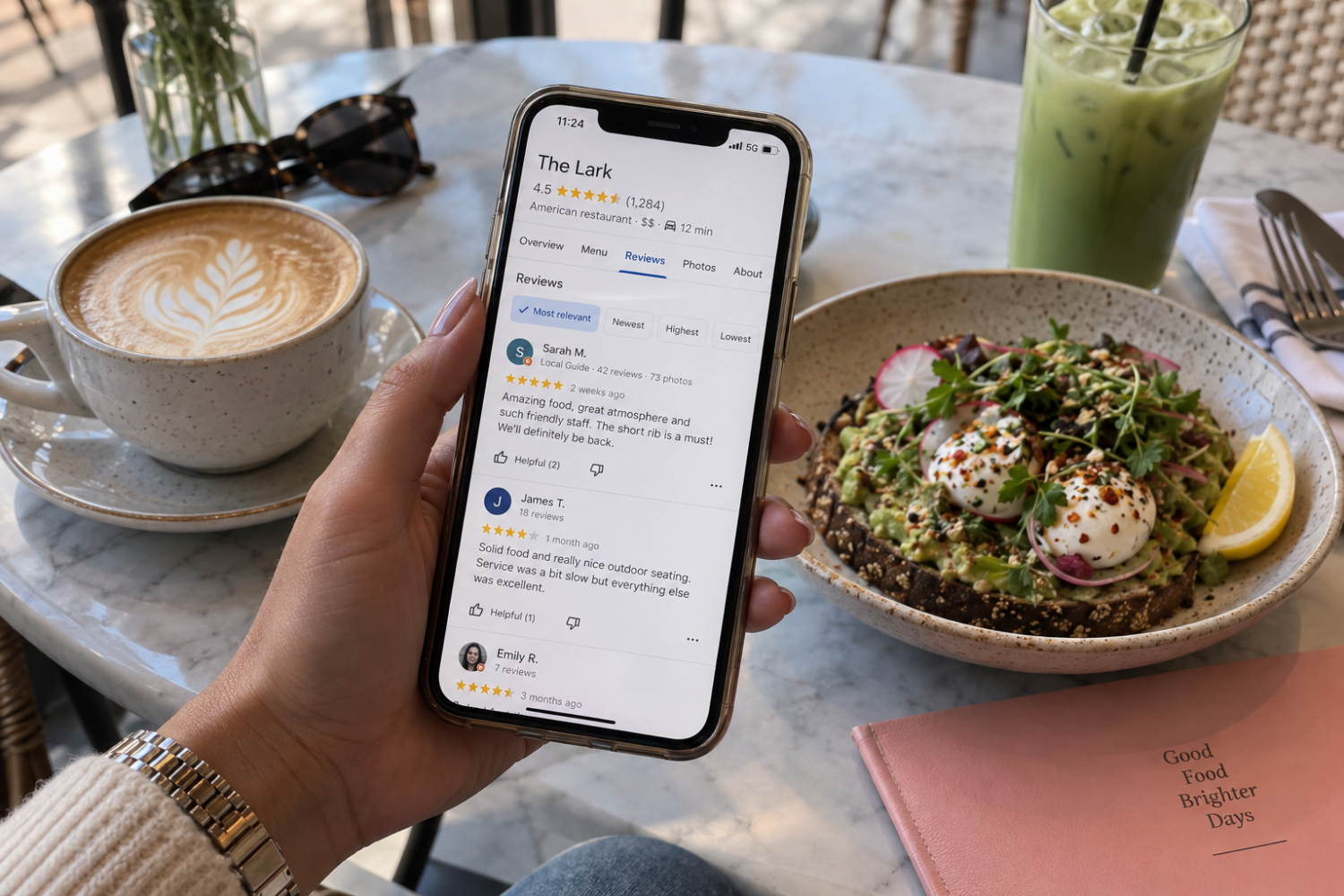
Before trying a new restaurant, what do many customers do?
They look it up.
They may check the menu, scroll through photos, look at the star rating and read a few recent reviews. And sometimes, before they've tasted the food or walked through the door, they've already formed an opinion about the restaurant.
Online reviews have effectively become part of a restaurant's digital front door. According to BrightLocal's 2026 Local Consumer Review Survey of 1,002 U.S. adults, 85% said positive reviews make them more likely to use a business, while 77% said negative reviews make them less likely to do so. The same research found that after reading positive reviews, 54% of consumers visit the business's website.
For restaurant operators, that means managing reviews shouldn't simply be about trying to achieve the highest possible star rating. It's about making the reviews you receive count.
Don't Focus Only on the Number of Stars
A 4.7 rating certainly looks good. But customers have considerably more information available than one number. They can see how recently reviews were posted, what customers are consistently saying, how the restaurant responds to complaints and whether the experience described in reviews matches what they're looking for.
BrightLocal's 2026 research found that consumers increasingly expect both strong ratings and recent reviews when evaluating local businesses. That means a restaurant's review profile isn't something that can be built once and forgotten. A restaurant with years of customer feedback but very little recent activity may tell a different story than one receiving a steady stream of current customer experiences.
Google and Yelp Have Different Rules About Asking for Reviews
This is one area where restaurants need to be careful because the major platforms don't follow identical policies.
Google allows businesses to ask customers for reviews.
Google specifically suggests sharing a review link or QR code with customers. However, Google prohibits offering incentives such as free or discounted products or services in exchange for posting, changing or removing a review.
Yelp takes a different approach.
Yelp explicitly tells businesses not to ask customers for Yelp reviews. It says businesses shouldn't ask customers, mailing list subscribers, friends or family to review the business, and shouldn't have employees compete to collect reviews. Yelp also warns that solicited reviews may not be recommended by its automated recommendation system.
So a generic strategy of putting “Review us on Google and Yelp!” everywhere isn't necessarily the right approach. Restaurants should understand each platform's rules and build their review strategy accordingly.
Make Leaving a Google Review Easy
If a customer has had a fantastic dinner, there is a relatively small window in which that experience is fresh. Don't make them search for your restaurant, find the correct Google listing and figure out where to leave feedback. Google allows businesses to create a review link or QR code that takes customers directly to the review process.
That can potentially be incorporated into appropriate customer touchpoints such as a receipt, follow up communication or other post visit interaction. The objective isn't to pressure someone into writing a glowing review. It's simply to remove unnecessary friction for customers who genuinely want to share their experience.
Don't Buy Your Way to Five Stars
Offering a free appetizer for a five star review might sound like an easy marketing strategy.
It isn't.
The Federal Trade Commission's Consumer Reviews and Testimonials Rule has been in effect since October 21, 2024. Among other provisions, it prohibits businesses from providing compensation or incentives that are expressly or implicitly conditioned on a consumer review expressing a particular sentiment.
The FTC makes an important distinction here. Its rule does not categorically prohibit every incentive for an honest review, provided the incentive isn't conditioned on whether the review is positive or negative. However, disclosure and other FTC requirements can apply, and individual review platforms may impose stricter rules.
For restaurants, the simpler approach is usually the better one:
Earn genuine reviews through genuine customer experiences and follow the rules of the platform where those reviews appear.
A Negative Review Isn't Just a Problem
Nobody enjoys receiving a one star review. But before dismissing it, look at what the customer is actually saying. One person complaining about slow service may simply represent one bad evening. Ten people mentioning slow service over several weeks may be telling you something operational.
The same applies to comments about food temperature, cleanliness, order accuracy, wait times, portion sizes, staff interactions or delivery packaging. Reviews can function as an informal feedback system. Individual reviews should be kept in perspective, but recurring themes deserve attention. That turns review monitoring from a marketing exercise into an operational one.
Your Response Isn't Only for the Person Who Complained
This may be the most overlooked part of review management.
Suppose a customer leaves a harsh review.
The restaurant responds defensively:
“That's not what happened. Our server explained the policy to you several times.”
Even if the restaurant is completely correct about what happened, consider how that exchange looks to the next 500 potential customers who read it. A public response has two audiences. The first is the person who wrote the review. The second is everyone deciding whether they want to become your next customer.
Google recommends that businesses keep responses professional, relevant and concise, personalize responses when appropriate and avoid personal attacks. For complicated situations, Google recommends asking the reviewer to continue the conversation privately by phone or email.
That's a useful framework for restaurants regardless of where the review appears.
Don't Copy and Paste the Same Response 100 Times
There's nothing inherently wrong with thanking customers for positive reviews.
But compare:
“Thank you for your review. We appreciate your business.”
with:
“We're so glad you enjoyed the sea bass and that Maria took great care of your table. We'll make sure she hears about it.”
The second response demonstrates that somebody actually read the review. Google itself recommends avoiding the same generic thank you on every review and instead using responses where the business can provide a useful update or genuinely acknowledge the customer's experience. Restaurants don't necessarily need to write paragraphs. They need to sound human.
Know When to Take the Conversation Offline
Some complaints can be resolved publicly in a few sentences. Others shouldn't be. A dispute involving a complicated bill, an employee, a reservation issue or a detailed customer complaint can quickly turn into an argument if both sides continue responding publicly.
A better response might acknowledge the concern, indicate that the restaurant wants to understand what happened and provide an appropriate way for the customer to contact management directly.
There is another reason to be cautious: privacy. Google specifically advises businesses not to share a reviewer's private information when responding publicly. The objective shouldn't be to win an argument online. It should be to demonstrate how the restaurant handles a problem.
Don't Try to Make Legitimate Negative Reviews Disappear
Restaurants should absolutely report reviews that violate a platform's policies. That's different from trying to suppress legitimate criticism. The FTC's rule prohibits certain review suppression practices, including using unfounded or groundless legal threats, intimidation or certain false accusations to prevent or remove negative reviews.
Businesses also need to be careful about practices that create a misleading picture of customer sentiment. A credible review profile doesn't necessarily mean having nothing but five star reviews.
In fact, Google notes that honest and balanced reviews can help potential customers make decisions and that a mixture of positive and negative feedback can appear more trustworthy.
Use Reviews to Find Problems You Can't See
Restaurant management can't be everywhere at once. Reviews can reveal patterns that might otherwise take months to identify. If multiple customers mention that takeout food arrives cold, investigate packaging and pickup times. If reviews repeatedly mention long waits despite empty tables, look at staffing, reservations and table turnover. If one menu item is repeatedly praised, that information is useful too.
Reviews shouldn't just sit on Google and Yelp. They can become another source of operational information. A multiunit restaurant group can take this even further by tracking recurring themes across locations.
Why does one location consistently receive praise for service while another struggles?
Why is one store repeatedly criticized for order accuracy?
The star rating tells you that customers are reacting.
The written reviews can sometimes help explain why.
Make Reviews Part of Restaurant Operations
Review management shouldn't belong exclusively to the marketing department. Operations creates most of what customers eventually review. Food quality, cleanliness, service, wait times, employee interactions, order accuracy and the way problems are resolved all begin inside the restaurant.
A useful review process could therefore be simple:
Monitor the major platforms regularly. Respond appropriately. Look for recurring themes. Share relevant feedback with the people who can actually address it. Then determine whether the same complaints continue appearing.
That closes the loop between customer feedback and restaurant operations.
The Goal Isn't a Perfect Review Profile
Restaurants are run by people and serve people. Not every customer will be happy, and not every review will be fair. Trying to create a flawless online reputation can push businesses toward shortcuts that violate platform policies, create distrust or, in some circumstances, run afoul of federal rules.
A stronger objective is to build a review profile that reflects a restaurant that listens. Make it easy for customers to leave feedback where platform rules permit it. Don't manufacture reviews. Don't reward people specifically for praising you. Respond professionally when something goes wrong. Pay attention when the same issue appears repeatedly.
And remember that when you respond to one customer online, you may actually be speaking to hundreds of future customers. That can make a thoughtful response almost as important as the review itself.