

Kitchen Equipment Decarbonization: Frequently Asked Questions

Carbon buildup is the hardened black layer that forms on pans, hood filters, oven racks, and other metal kitchen equipment after enough cycles of heat and grease. Decarbonization is the process of getting it off and taking the item back to bare metal.

Professional kitchen, view counter in stainless steel

Carbon buildup is the hardened black layer that forms on pans, hood filters, oven racks, and other metal kitchen equipment after enough cycles of heat and grease. Decarbonization is the process of getting it off and taking the item back to bare metal.Below are the questions commercial kitchen operators ask us most: how decarbonizing works, what it cleans, what it costs in labor and water, how to fit it into a routine that already has no spare time in it, and if there’s a cost-effective solution. If your question isn’t here, contact us and our team is happy to answer it directly.

JUMP TO SECTIONS:
Decarbonization Basics

What is decarbonization in a commercial kitchen?

Decarbonization is the removal of carbonized grease and food residue from cooking equipment. Every time a pan, rack, or filter goes through a heat cycle with fats, oils, and grease (FOG) present, a thin film bonds to the metal instead of washing away. Repeat that daily and the film hardens into carbon that detergent and scouring cannot remove, however much effort goes into it. Decarbonizing dissolves that layer and returns the item to the surface it had when it was new.

What causes carbon buildup on kitchen equipment?

Heat plus oil causes carbon buildup. Grease that sits on a hot surface oxidizes and bonds to the metal of your cookware and kitchen equipment rather than lifting off. Sheet pans, fry baskets, hood filters, and fryer parts see it fastest because they live in the heat. Sink water cools quickly, and once it drops below the temperature where that bond releases, part of the layer stays behind and the next shift adds to it.

Is carbon buildup a real problem for commercial kitchens or just a cosmetic one?

Carbon buildup shows up on the P&L in four places:

  1. Pans carrying carbon buildup conduct heat unevenly, so food browns in patches and can pick up flavors from whatever was cooked before it.
  2. Hood filters coated in grease raise fire risk.
  3. Carbon also does not respond well to scrubbing efforts, so the hours a team spends attacking it wear down the equipment in your kitchen without solving anything.
  4. An inspector walking your line notices the same carbon buildup your team stopped seeing months ago, risking your compliance with health codes.

Can you remove carbon from kitchen equipment with steel wool or a scouring pad?

No. Steel wool and aggressive scouring do not remove carbon buildup. They will polish the metal around it and leave scratches behind, but the carbon is bonded to the surface and abrasion doesn’t break that bond. What breaks it is sustained heat and the right chemistry, which is why soaking works on carbon and elbow grease does not.

How does decarbonizing improve cleanliness in my kitchen?

Sanitation only works on a surface that is actually clean underneath. Carbon is porous, and it holds grease and residue that sanitizer cannot reach, so an item can look washed and still carry buildup in the seams and corners. Decarbonizing takes the item back to bare metal, which gives you a surface that can be sanitized properly. Items pulled from a heated soak tank running at 185° F come out clean and fully sanitized, with no bacteria or germs left on them.

Our kitchen is new and everything still looks clean. Do we need to decarbonize?

That’s actually the best time to start! Carbon buildup is cumulative, and kitchen equipment that gets decarbonized from the first week never develops the layer at all. The savings start on day one too, so the sooner a system goes into place, the more money you keep.

Back to top

How The Decarbonization Process Works

How do you decarbonize kitchen equipment and cookware?

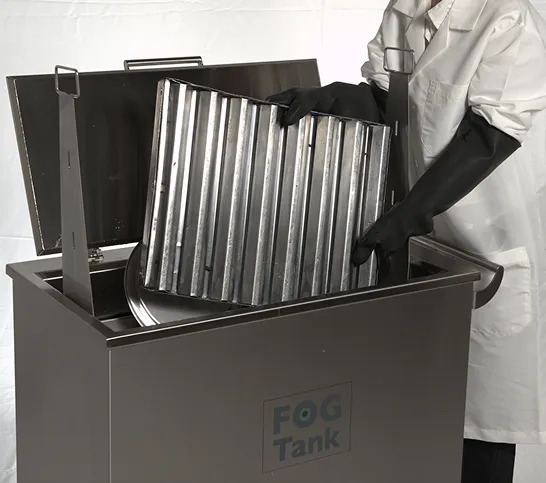
The method that takes the least labor is a heated soak. You fill The FOG Tank®, which is an insulated soak tank, with water and a carbon removal powder, hold it at 185° F, and submerge the dirty items so they go under the water and stay under the water. Heat and chemistry break the bond between the carbon and the metal while your kitchen equipment and cookware sits. Nobody scrubs it. When it’s done, you just remove the item and rinse it.

How long does it take to decarbonize an item?

It depends on how much carbon is on it. Lightly soiled cookware can be ready after about ten minutes in The FOG Tank®. Kitchen equipment carrying years of carbon buildup takes longer and can be left in our heated soak tank overnight without any risk to the metal, because the solution is non-caustic and won’t wear down your equipment.

Does cookware and kitchen equipment need to be rinsed after it’s decarbonized?

Yes. Remove each item from the heated soak tank and rinse it to clear the softened residue. That step is required, not optional, and can be completed quickly and easily.

What happens if someone forgets to scrape off loose food before decarbonizing equipment in a heated soak tank?

Nothing is ruined and the item still comes out clean. Scraping isn’t what keeps The FOG Tank® working, and the water turns dark after the first wash no matter what goes in. The reason we recommend scraping is what happens over the rest of the month. Loose food debris settles to the bottom of the tank and sits there until the water gets changed, which is a little like leaving a trash can of stale food in an office for four weeks. It will eventually let you know it’s there. Knock off what comes away easily from your cookware and equipment and the tank stays pleasant to be around.

Does kitchen equipment have to be separated, or can they nest and still decarbonize in a soak tank?

They can nest in The FOG Tank®. Pans stack inside each other and racks sit alongside them, which means a single load holds considerably more than the footprint of the tank suggests.

How often does a heated soak tank’s water and powder need to be changed?

Water and powder only need to be added once a month to The FOG Tank®. One fill of water and a set amount of carbon removal powder, based on the size of your tank, hold full cleaning strength for the whole month. That’s true whether the tank runs a few times a week or around the clock. In between loads the tank keeps working, so nothing gets drained and mixed again for the next batch of items the way sink water does.

How do I fill a soak tank?

You can fill The FOG Tank® with the drain hose that comes with the unit or with any standard hose. Fill it with water at the start of the month to the fill line and add Tiger Carbon Removal Powder. The amount depends on the size of your tank, and it’s the same amount every month, so there’s nothing to measure out or calculate once you know the amount. The tank comes up to temperature on its own from there.

How do I dispose of the soak tank’s water at the end of the month?

Unplug The FOG Tank® the night before and let the water cool down first. Hot water can’t go down a floor drain, so this is a mandatory step. Once it’s cooled, the water goes down the drain like any other wastewater. The powder used is non-toxic and fully biodegradable, so there’s no hazardous waste pickup and no special permit to keep on file.

The water in the soak tank looks dirty. How do I know my kitchen’s items are coming out clean and decarbonized?

What you’re looking at is the buildup that used to stay on your kitchen equipment and cookware. Color has nothing to do with cleaning strength: the solution holds its power for the full month in The FOG Tank®, and the 185° F operating temperature is what sanitizes your items. In fact, discolored water is evidence the process is working, not a sign it needs attention.

Back to top

Decarbonization Safety And Surface Compatibility

What kind of cleaning agent does decarbonizing require?

Contrary to popular belief, decarbonizing doesn’t require caustic chemistry. Conventional oven and carbon removers rely on it, which is why they arrive with warnings about skin contact and ventilation. A heated soak tank uses a non-caustic, non-toxic powder and lets temperature and time do the work that harsh chemicals and a scrub pad would otherwise have to do.

Is decarbonizing safe for aluminum and food-contact surfaces?

Yes, when the chemistry is non-caustic. Our Tiger Carbon Removal Powder is safe for aluminum. It’s also safe for stainless steel and every other metal in a commercial kitchen, and it’s safe on food-contact surfaces too. The powder is fully biodegradable and leaves nothing behind that would compromise an item going back into service.

Does my team need protective equipment to decarbonize our kitchen equipment and cookware?

For The FOG Tank®, all that’s needed is a pair of gloves. That’s not because of the chemistry, which is safe to handle, but because the water is held at 185° F. Treat it the way you treat any other heat source on the line. Providing gloves is a straightforward way to show your staff that management takes their safety seriously.

Does decarbonizing sanitize, or only clean commercial kitchen equipment?

Both, when it happens in a heated soak tank. At 185° F, the water in The FOG Tank® is above the temperature required to sanitize, so your kitchen’s items come out clean and sanitized in the same step and are ready for service after a rinse.

What temperature is required to decarbonize our cookware and equipment?

We recommend 185° F, held at a steady temperature. That’s the point where the bond between carbon and metal releases reliably. Because The FOG Tank® is an insulated soak tank, it holds that temperature on its own while the lid is closed. Opening the lid to load or unload exposes the water to cold air and the temperature drops, at which point the thermostat registers the change and switches the heater back on only until the water returns to 185° F, making it an energy-efficient and cost-efficient solution.

Back to top

What Decarbonization Cleans

Which items from my commercial kitchen can be decarbonized?

Metal kitchen equipment and heavy-duty plastic items can go in The FOG Tank® to be decarbonized. That includes sheet pans, hood filters, fry baskets, pots and pans, oven racks, muffin tins, cutting boards, pizza pans, pizza screens, pizza belts, Cambro containers, steam table pans, and more, provided it can withstand 185° F.

What should stay out of a heated soak tank?

Dishes and glassware should be cleaned in your three-compartment sink. Coated items belong out of your heated soak tank as well. If a nonstick or Teflon coating is anything less than high quality, or if it has already started to lift, the soak will strip it.

Anything that can’t tolerate 185° F should stay out of The FOG Tank® too, so it’s worth checking plastic items and delivery trays before their first load. Kitchen surfaces are a separate job as well. Floors, mats, walls, and oven interiors can be cleaned with GrimeGo®, our all-purpose degreaser, which is never added to the soak tank.

Can we get rid of our three-compartment sink if we get a soak tank to clean and decarbonize our cookware and kitchen equipment?

A heated soak tank handles nearly everything a three-compartment sink handles, from daily cleaning of metal and heavy-duty plastic cookware to removing carbon that’s been building up for years, and it does so without scrubbing and without draining between loads. Dishes and glassware are the main exception, and they continue to be cleaned in your sink. Health codes also require you to have a three-compartment sink regardless, though the more items your team moves into the tank to clean, the more you save on labor and water.

How does decarbonizing in a soak tank compare to cleaning in a three-compartment sink?

A heated soak tank takes carbon off metal kitchen equipment that a sink cannot reach at all, and it does it without anyone scrubbing. Heat is the reason why. Sink water begins cooling the moment after it’s drawn and has to be drained and replaced every hour or two, which means it spends most of its working life below the temperature where carbon releases. The FOG Tank® holds water at 185° F continuously for a full month on a single fill.

Where the two methods really differ is what they cost you to run. The sink consumes fresh water and chemicals on every cycle and occupies a station while items soak. The tank consumes one fill of water and one batch of powder, whether ten loads go through it or a hundred.

Can a dish machine decarbonize a kitchen’s pans and hood filters?

No, and it was never built to. A dish machine runs a short cycle with detergent formulated for food residue on dishware, which is exactly what most kitchens need it for. Carbon is a different problem. It bonds to the metal, and breaking that bond takes sustained heat and dwell time that a wash cycle measured in minutes cannot deliver. Sheet pans and hood filters come out of a dish machine looking better while still carrying the layer of carbon.

Keep your dish machine for what it does well. Send your metal kitchen equipment into The FOG Tank®.

Does decarbonizing hood filters reduce the risk of fire in a kitchen?

It removes the fuel. Hood filters cleaned in a heated soak tank come back to bare metal, so there’s no grease left in the mesh for a flare to catch. CaptiveAire endorses The FOG Tank® as the best method for cleaning hood filters. How often your filters need cleaning will depend on your cooking volume, the type of cooking you’re doing, and the fuel type you use under NFPA 96, and your local fire authority has the final say.

Can decarbonizing improve a commercial kitchen’s food quality?

Yes, and it’s one of the first things chefs notice when you actually start decarbonizing cookware and equipment fully. A pan with carbon on it conducts heat unevenly, so food cooks inconsistently and can carry flavors from previous services. Take the pan back to bare metal and it performs the way it was built to perform.

Back to top

The Savings That Come From Decarbonizing Your Kitchen Equipment And Cookware

Can decarbonizing cookware and equipment reduce a commercial kitchen’s operating costs?

Decarbonizing items with The FOG Tank® can cut costs in several places at once:

  • Labor: The FOG Tank® can take half an hour a day or more out of cleaning, and that’s time your team spends on something that earns you money instead.
  • Water: Because one fill of water lasts a month in The FOG Tank®, whereas a sink gets drained and filled every hour or two, a single location can save over 340,000 gallons a year with our soak tank.
  • Energy: The fact that The FOG Tank® is insulated means it retains heat and spends less energy, which can save a single restaurant location $3,000 or more a year. Your kitchen equipment also lasts longer when nobody is damaging it with steel wool as they try to decarbonize it.

How do we budget for cleaning and decarbonizing our kitchen’s equipment with a soak tank?

With The FOG Tank®, the cost is fixed and known in advance. One tank, and the same amount of water and powder every month. There’s no guessing at how much chemical a heavy month will consume and no cleaning supply line that moves around on you, because consumption doesn’t change with volume.

What kind of return should we expect from a heated soak tank?

Many customers report a return on their investment for The FOG Tank® within six to eight months, and the savings start the day the tank goes into service rather than at the end of a payback period.

How does decarbonizing in a soak tank support sustainability goals?

Water is the clearest sustainability win. Sink cleaning uses fresh water for every cycle, while The FOG Tank® uses one fill of water a month, which can save a single location 340,000 gallons of water each year. Chemical volume drops for the same reason. The powder we use is biodegradable and non-toxic, so what leaves the building at the end of the month doesn’t need any hazardous waste handling. Equipment that isn’t being scoured month after month also stays in service longer, which keeps stainless steel out of the waste stream.

Back to top

Decarbonization By Operation Type

Which industries decarbonize their kitchen equipment and cookware?

Any operation cooking at volume can benefit from decarbonizing their kitchen’s items in a heated soak tank. Restaurants, hotels, hospitals, schools and universities, casinos, bakeries, supermarkets, caterers, cruise ships, and more all run into the same carbon buildup on their kitchen equipment.

Does the process of decarbonizing kitchen items change between a bakery and a hospital?

The decarbonization process works the same way for everyone when you use The FOG Tank®. What changes is the load itself. A bakery is cleaning sheet pans, muffin tins, proofing racks, and screens in volume, so it needs room for large, flat items. A hospital is cleaning steam table pans, delivery trays, and cookware on a schedule that never fully stops, so it needs capacity to keep up around the clock. A supermarket deli is working through rotisserie racks and fryer parts. The tank size you need differs based on your operation, but the method you’ll use does not.

What about school kitchens that close for part of the year? How does a heated soak tank account for that?

It depends on whether you buy or lease The FOG Tank®. If you purchase the tank, we can pause chemical shipments for the months your kitchen is closed, so a school that goes dark over summer break isn’t paying for powder nobody will use. Leases work differently. The monthly payment continues because the equipment stays on site with you, and we are contractually obligated to ship chemicals for every month of the lease term. For operators with a seasonal calendar, it’s worth having a conversation with our team about your needs before deciding between the two.

We don’t have space in the kitchen. Where would a soak tank go?

There’s good news: The FOG Tank® doesn’t have to go in your kitchen! Because it’s filled and emptied once a month, it doesn’t need to live next to a sink. Our most popular size fits under the drainboard of a three-compartment sink or under a standard countertop, and it uses roughly 60% less space than the sink itself. If floor space is genuinely tight, a back room or a storage shed works fine, as long as the area is covered and isn’t exposed to the elements.

Back to top

Questions About The FOG Tank®

What is The FOG Tank®?

The FOG Tank® is the original heated soak tank for commercial kitchens. It is an insulated, 304 stainless steel tank that holds water and Tiger Carbon Removal Powder at a thermostatically controlled 185° F. Your team loads kitchen equipment in and closes the lid. What comes back out is clean and sanitized. Every unit is UL Listed and NSF Approved, and our tank is already trusted by thousands of kitchens in all 50 states and worldwide.

What sizes does The FOG Tank® come in?

We offer a range of sizes to accommodate whatever your operation needs, from a unit that tucks under a countertop to models built for high-volume production kitchens. Rather than choosing from a chart, tell our team what you’re cleaning and how much of it, and we’ll point you to the right FOG Tank.

Can we lease a FOG Tank or do you have to buy it?

Both purchase and leasing options are available for The FOG Tank®, and our team can walk you through either path.

Should we purchase or lease a FOG Tank?

Both options are open, and the right one usually comes down to how your operation prefers to handle the expense.

Purchasing works well for operators who would rather own the equipment outright and treat it as a capital purchase, particularly single locations planning to keep the tank in service for the long haul, which is a reasonable expectation given that we have tanks still in service today that have been in service for over 20 years.

Leasing can be preferable for operators who would rather keep it on an operating line, and it tends to make rollouts across multiple locations easier to approve, since no single site is carrying a large upfront number on its own.

Either way, our team sizes the tank to what you’re actually cleaning before anything gets quoted. Tell us the equipment and the volume, and we’ll walk you through both paths with real numbers for your kitchen.

How do I get pricing?

Request a quote and someone from our team will get back to you. Pricing comes from an expert who has asked about your kitchen first, so we can make sure you get the right size for your needs. Call (858) 566-6212 or fill out our contact form to start that conversation.

Can we try The FOG Tank® in our own kitchen first?

Yes. We give you seven days to test out The FOG Tank® in your own kitchen, starting the day the unit arrives. Put it to work on your real loads, and if you decide it isn’t the right fit, for any reason or for no reason at all, send it back and we will refund you (minus freight costs). Payment is collected before the unit ships. You can also look through our case studies and customer results from operations similar to yours to see how it works for others.

How long has The FOG Tank® been around?

Hyginix has been manufacturing heated soak tanks for over 30 years, and we still have tanks in service today that have been in service for over 20 years.

Where do you sell FOG Tanks?

We serve thousands of commercial kitchens in all 50 states and worldwide. Contact our team to get yours.

How do I reach someone with a question about The FOG Tank®?

Call (858) 566-6212 or fill out our contact form to get in touch with our team directly.

Back to top

Purchasing Or Leasing The FOG Tank® At A Glance

Both options put the same tank in your kitchen. The difference is how the cost hits your books.

Whichever column you land in, our team sizes the tank to what you are actually cleaning before anything gets quoted to help you find the right fit.

 Purchasing The FOG Tank®Leasing The FOG Tank®
How you payOne payment upfront for the tank itself.A monthly payment spread across the term.
OwnershipThe tank is yours outright. Our tanks are built to stay in service for decades, and we still have units working in kitchens today after more than 20 years in the field.The tank stays in your kitchen but ownership stays with us. Built to our high standards, it can be used for many, many years to come.
Sizes availableThe full range is available, from the compact model that fits under a counter up to the largest production tanks.
What comes with itThe lifting basket and drain hose are included with every unit, along with wall charts in English and Spanish that use pictures to walk staff through daily use and the end-of-month water change. The first three months of Tiger Carbon Removal Powder also ship inside the tank.
Chemical supplyTiger Carbon Removal Powder ships quarterly. If your kitchen operates seasonally, we can pause shipments for the months you are closed.Powder ships quarterly and payment occurs monthly, including any months your kitchen is closed, since the equipment stays on site with you.
Customer supportPhone call or email, answered by someone who knows the equipment.

Purchasing The FOG Tank®

  • How you pay: One payment upfront for the tank itself.
  • Ownership: The tank is yours outright. Our tanks are built to stay in service for decades, and we still have units working in kitchens today after more than 20 years in the field.
  • Sizes available: The full range is available, from the compact model that fits under a counter up to the largest production tanks.
  • What comes with it: The lifting basket and drain hose are included with every unit, along with wall charts in English and Spanish that use pictures to walk staff through daily use and the end-of-month water change. The first three months of Tiger Carbon Removal Powder also ship inside the tank. 
  • Chemical supply: Tiger Carbon Removal Powder ships quarterly. If your kitchen operates seasonally, we can pause shipments for the months you are closed.
  • Customer support: Phone call or email, answered by someone who knows the equipment.

Leasing The FOG Tank®

  • How you pay: A monthly payment spread across the term.
  • Ownership: The tank stays in your kitchen but ownership stays with us. Built to our high standards, it can be used for many, many years to come.
  • Sizes available: The full range is available, from the compact model that fits under a counter up to the largest production tanks.
  • What comes with it: The lifting basket and drain hose are included with every unit, along with wall charts in English and Spanish that use pictures to walk staff through daily use and the end-of-month water change. The first three months of Tiger Carbon Removal Powder also ship inside the tank.
  • Chemical supply: Powder ships quarterly and payment occurs monthly, including any months your kitchen is closed, since the equipment stays on site with you.
  • Customer support: Phone call or email, answered by someone who knows the equipment.

Take Your Equipment Back To Bare Metal With The FOG Tank®

Tell us what your kitchen is cleaning and how often, and we’ll help you land on the right size FOG Tank® for the job. Request a quote or call now at (858) 566-6212.