
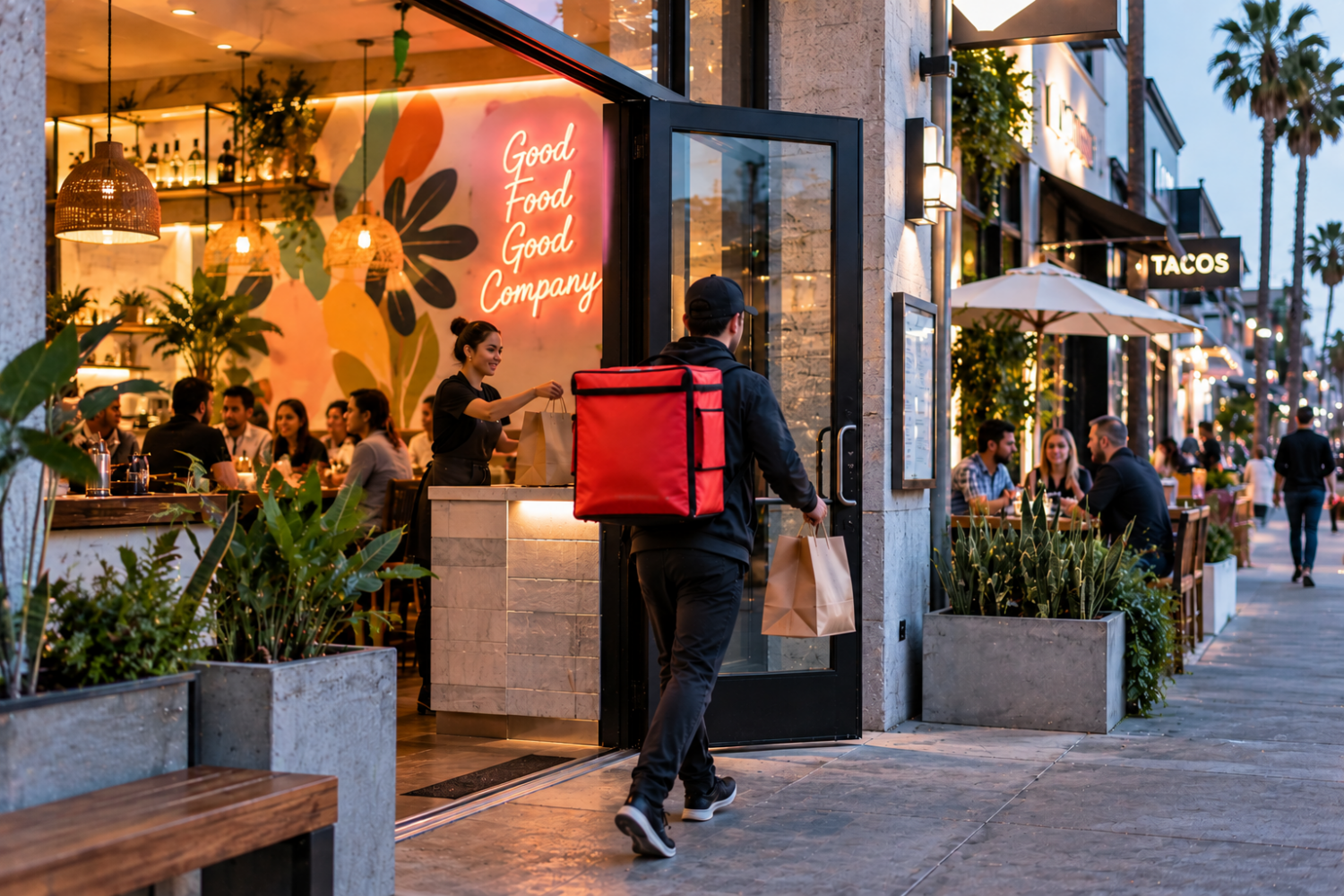
Third party delivery has become a major part of how consumers interact with restaurants.
For operators, however, the decision to join platforms such as Uber Eats or DoorDash isn't as simple as asking whether delivery can generate more orders.
The more important question is:
Are those additional orders actually good for your restaurant?
Delivery platforms can introduce a restaurant to customers who may never have discovered it otherwise, provide access to an established delivery network and create an additional revenue channel without requiring a restaurant to build its own delivery operation. But those benefits come with costs.
Before signing up, restaurant operators should look beyond order volume and consider profitability, kitchen capacity, menu design, customer experience and whether delivery complements the operation they already have.
The Biggest Advantage: Access to Customers
One of the strongest arguments for joining a third party delivery platform is reach. Consumers are already using these marketplaces to decide what to eat. Being present allows a restaurant to appear when someone searches the app for dinner rather than requiring that customer to already know the restaurant exists.
This isn't a small customer segment. In a May 2026 National Restaurant Association survey, 68% of delivery customers said they had used a third party delivery service during the previous six months. Usage was particularly high among Gen Z adults and millennials. For a restaurant trying to attract new customers, that exposure can be valuable.
Uber Eats, for example, includes restaurant discoverability in its marketplace plans, while DoorDash describes its marketplace as a way for restaurants to reach customers already ordering through DoorDash. In that sense, part of the fee a restaurant pays isn't simply for transporting food. The restaurant is also paying for access to an existing marketplace.
The Biggest Concern: What Does the Order Actually Cost You?
This is where operators need to look carefully at the numbers. As of September 2026, Uber Eats lists standard U.S. marketplace fees of 20% for its Lite plan, 25% for Plus and 30% for Premium, although rates can differ in certain markets. DoorDash currently lists delivery commissions of 15% for Basic, 25% for Plus and 30% for Premier for eligible U.S. restaurants. That means a restaurant shouldn't evaluate delivery based solely on the revenue appearing on a sales report.
Consider a hypothetical $40 order. At a 25% marketplace commission, $10 of that order would go toward the platform commission before considering the restaurant's food cost, labor, packaging and other operating expenses.
That does not mean the restaurant loses money on the order. It means operators need to understand the contribution that remains after all of the costs associated with fulfilling it. Recent industry data shows why that calculation matters. Among restaurants offering third party delivery in the National Restaurant Association's May 2026 survey, 45% reported that their third party delivery orders were not profitable. The result was 47% among full service restaurants and 43% among limited service restaurants.
That doesn't mean third party delivery is inherently unprofitable. More than half of surveyed operators reported that it was profitable. It does mean profitability should be measured rather than assumed.
More Orders Aren't Always Better Orders
Imagine your dining room is busy at 7:00 PM. The kitchen is working through dine in tickets when another stream of orders begins arriving from delivery apps. Those orders may increase revenue, but they also compete for the same kitchen capacity. The restaurant still has a finite number of employees, cooking surfaces, fryers, ovens, prep stations and pieces of cookware. That creates an important operational question:
Can your kitchen absorb additional delivery volume without hurting the customers you already have?
A delivery strategy that works beautifully at 3:00 PM might create problems during the Friday dinner rush. Operators should therefore look at delivery as an operational channel, not simply another ordering method.
Your Entire Menu Doesn't Necessarily Belong on a Delivery App
A dish that is excellent when it leaves the kitchen isn't necessarily excellent 30 minutes later. Some foods travel better than others. Temperature, texture, sauces, packaging and transit time can all affect what eventually reaches the customer. That creates an opportunity to think strategically about the delivery menu.
Rather than automatically placing the entire restaurant menu online, operators can evaluate which dishes travel reliably, which are operationally practical to produce and which make financial sense after delivery related costs are considered. Menu decisions can also affect kitchen complexity.
If a low margin dish requires significant preparation, specialized packaging and substantial kitchen time, high delivery volume doesn't automatically make that item attractive.
The question isn't simply “Will customers order this?”
It is also “Do we want them ordering this through this channel?”
Delivery Can Solve a Logistics Problem
Building an independent delivery operation requires more than accepting orders. Someone has to deliver them. Third party platforms solve much of that logistical problem by providing access to delivery networks without requiring individual restaurants to recruit, schedule and manage their own fleet of drivers.
Both Uber Eats and DoorDash also offer alternatives that separate ordering from delivery fulfillment. Uber Direct, for example, allows businesses to request delivery for orders placed through their own channels rather than requiring those orders to originate in the Uber Eats marketplace. DoorDash similarly offers products outside its traditional marketplace model.
That distinction matters because restaurants increasingly have more choices than simply “use a delivery app” or “deliver everything ourselves.”
Don't Forget the Customer Relationship
There is another consideration that doesn't appear as neatly on a profit and loss statement. Who owns the relationship with the customer? When someone orders directly from a restaurant, the restaurant has much greater control over the ordering experience and its relationship with that guest.
Marketplace orders introduce another company between the restaurant and the customer. That doesn't necessarily make marketplaces bad. Their ability to introduce restaurants to new customers is part of their value. But it suggests a useful distinction:
Discovery and loyalty don't necessarily have to happen through the same channel.
Restaurants can use third party marketplaces as one way customers discover them while also making direct ordering easy for customers who already know the brand.
Both major platforms now offer tools supporting direct ordering as well. Uber's Webshop allows restaurants to take orders through their own online storefront, while DoorDash offers Online Ordering for restaurant websites. Their fee structures differ substantially from their marketplace offerings, so operators should compare the current terms applicable to their business.
Should You Raise Your Delivery Menu Prices?
Many restaurants already do. According to the National Restaurant Association's May 2026 survey, 83% of limited service operators and 66% of full service operators using third party delivery said they charged more for menu items ordered through third party providers than for the same items ordered for dine in or takeout.
But increasing prices isn't automatically the right answer. Operators need to consider platform agreements, applicable laws, customer expectations, competitors and how much of a premium customers will accept for convenience. More importantly, pricing shouldn't replace understanding the economics of the order.
If a restaurant doesn't know its costs, changing the menu price is still largely guesswork.
Measure What Happens After You Join
A delivery partnership shouldn't be treated as a decision you make once and never revisit. Track it. Look at delivery sales, commissions and other fees, packaging expenses, average order value, refunds and errors, preparation times and the effect delivery orders have on kitchen operations. Also look beyond revenue.
If delivery generates significant sales but creates bottlenecks that negatively affect dine in service, that matters. If it generates orders during periods when the kitchen otherwise has unused capacity, that matters too. The same delivery platform can therefore have very different value for two restaurants, or even for the same restaurant at different times of day.
So, Is Third Party Delivery Worth It?
There isn't one answer for every restaurant.
For some operators, platforms such as Uber Eats and DoorDash provide valuable exposure, additional orders and delivery infrastructure that would be difficult to recreate independently.
For others, commissions, kitchen constraints or menu economics may make certain delivery orders less attractive.
The key is not to confuse more sales with better business.
Before choosing a platform or pricing tier, operators should understand what they are paying for, determine which menu items make sense for delivery, evaluate whether their kitchen can absorb the additional volume and calculate what remains from an order after the costs of fulfilling it.
Then keep measuring.
Third party delivery should earn its place in a restaurant's operation just like any other sales channel.