

Commercial kitchens run on cleaning. Every shift, your team is wiping, scrubbing, soaking, and degreasing. The products you choose for that work impact your equipment, your staff, and, ultimately, your food. Yet most operators still select cleaning chemicals based on habit, availability, or the assumption that “stronger” means “better,” without considering non-toxic kitchen cleaners that may be safer.
That assumption has real costs. According to OSHA, workers across the country suffer more than 190,000 illnesses annually related to chemical exposures, and commercial kitchens are among the environments where that risk is most present. Caustic degreasers require Safety Data Sheets posted at the point of use under OSHA regulations, and improper handling puts staff at risk every time a bottle is opened. Then there's the wear those chemicals inflict on your cookware, your stainless steel, and your aluminum equipment over months and years of repeated use.
Choosing a non-toxic kitchen cleaner is not about sacrificing cleaning power. It's about finding the right match for the job. The right cleaning products will protect your people, preserve your equipment, keep you compliant, and still cut through grease, carbon, and grime.
Keep reading to learn how to make that decision, download a free checklist for choosing a kitchen cleaner, and get recommendations for specific products to clean specific surfaces and soil types.
Table of Contents:
- What a "Non-Toxic" Kitchen Cleaner Actually Means in a Commercial Foodservice Setting
- What Does “Non-Caustic” Mean for Commercial Kitchens?
- The Surfaces and Soils That Actually Need Cleaning (And What Your Non-Toxic Kitchen Cleaner Needs to Do)
- What to Look for When Evaluating a Kitchen Cleaner (Free Downloadable Checklist Included)
- Why a Soak-Based System Is a Game-Changer for Cleaning Kitchen Equipment
- Matching the Right Kitchen Cleaner to the Right Job
- The Business Case for Non-Toxic Kitchen Cleaning
- Choosing the Best Non-Toxic Kitchen Cleaner Matters More Than It Seems
What a "Non-Toxic" Kitchen Cleaner Actually Means in a Commercial Foodservice Setting
The term “non-toxic” gets used pretty loosely, so it helps to nail down what it actually requires in a professional kitchen environment.
A food-safe, non-toxic cleaner should meet several practical criteria:
- It must be formulated with ingredients approved by the FDA or USDA for food-contact surfaces.
- It should clean thoroughly and leave no harmful residue after rinsing.
- It needs to be non-reactive with the materials in your kitchen, including stainless steel, aluminum, and plastic.
What Does “Non-Caustic” Mean for Commercial Kitchens?
A related term you'll see is "non-caustic." The distinction between “non-toxic” and “non-caustic” matters, especially for equipment cleaning.
Caustic degreasers rely on strong alkaline chemicals like sodium hydroxide to break down grease. They work fast and powerfully, but they're hazardous to skin, eyes, and respiratory systems, require protective gear, and can corrode aluminum and certain plastics with repeated use.
Non-caustic formulas use milder, often biodegradable ingredients that are safer for the people using them and compatible with a wider range of surfaces. Non-caustic does not mean low-performance. It means the chemistry is doing the work differently, in a way that doesn't require you to trade staff safety for cleaning results.
The Surfaces and Soils That Actually Need Cleaning (And What Your Non-Toxic Kitchen Cleaner Needs to Do)
Understanding what you're up against helps you choose products that are a genuine fit for the task. Commercial kitchens face a few distinct cleaning challenges that each call for a different approach.
Surface / Soil Type | The Problem | What the Cleaner Needs to Do |
Fat, oil, and grease (FOG) on cookware and pans | Daily accumulation on pots, pans, fry baskets, and smallwares. Most operations default to the three-compartment sink, but staff drain and refill compartments every 1 to 2 hours as the water cools, requiring water, chemicals, and labor with every cycle. | Cut through FOG without requiring constant water changes or single-use chemical mixing. Stay active across multiple cleaning loads. |
Heavy carbon buildup | The stubborn, baked-on black residue that standard dish machines and hand scrubbing rarely resolve. Many kitchens quietly write off equipment and throw it away rather than fight the carbon. | Break down carbonized buildup without abrasive scrubbing or caustic chemistry that damages the equipment itself. |
Hood filters | One of the most overlooked maintenance tasks in a commercial kitchen, and one of the most consequential. Unclean filters can raise the risk of fires as well as poor indoor air quality. Filters cleaned in a three-compartment sink waste water and chemicals that must be replaced after every use. | Remove grease thoroughly and efficiently, without a single-use soak that ties up the sink and drains resources. |
Floors, mats, and oven interiors | High-contact surfaces that accumulate grease daily and create slip and contamination risks if not cleaned consistently. | Cut grease on contact, leave no slippery residue, and be safe across the variety of materials these surfaces involve. |
What to Look for When Evaluating a Kitchen Cleaner
Before committing to any product for your operation, run it through 6 criteria: staff safety, surface compatibility, environmental footprint, residue behavior, regulatory fit, and true cost per use. Each one can reveal a problem that won't show up on a product label.
We put these into a printable checklist you can use when evaluating any cleaner. It includes the key questions to ask for all 6 criteria so your team can easily and consistently assess products. Download the checklist here.
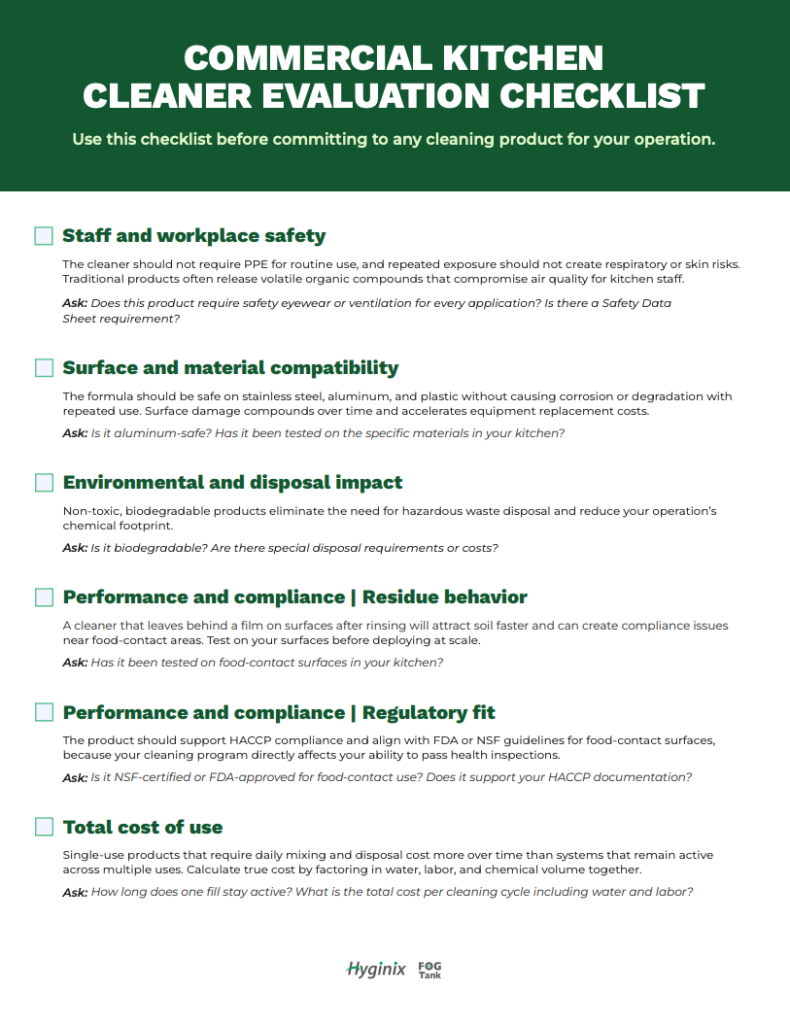
The short version: A kitchen cleaner should be usable without PPE, safe on aluminum and stainless steel, biodegradable, residue-free on food-contact surfaces, HACCP-compatible, and genuinely cost-effective when you factor in water, labor, and how long each fill stays active. Look for a non-toxic kitchen cleaning product that passes all 6 criteria to run your operations as smoothly and safely as possible.
Why a Soak-Based System Is a Game-Changer for Cleaning Kitchen Equipment
For the category of soils that matter most in commercial kitchens, namely fat, oil, grease, and heavy carbon on metal equipment, a soak-based cleaning system with a non-caustic powder offers something conventional cleaners cannot: continuous, hands-off cleaning without scrubbing or caustic chemistry.
The FOG Tank® is a heated soak tank designed specifically for commercial kitchen equipment. The cleaning agent that powers it is Tiger Carbon-Removal Powder, a proprietary formula that is non-caustic, non-toxic, fully biodegradable, aluminum-safe, food-safe, and completely safe for the people using it.
The way it operates is what sets it apart from a three-compartment sink. You fill the tank once with water and Tiger Carbon-Removal Powder, and that solution stays active for a full month, whether you use it once a week or run it around the clock. There’s no daily draining, no repeated chemical mixing, no single-use water waste. Staff simply load pots, pans, fry baskets, and hood filters into the tank, close the lid, and walk away. Items come out fully sanitized and bacteria-free, with no scrubbing required.
The monthly model also changes the water conservation picture significantly. Operations using The FOG Tank® can save over 340,000 gallons of water per year compared to conventional three-compartment sink cleaning. That's not a marginal improvement. It's a structural change to how a kitchen uses one of its most basic resources.
For heavy carbon buildup specifically, this approach resolves a problem most cleaning products sidestep entirely. Carbon that has baked onto pans over months of use usually resists standard degreasers, requiring intense physical scrubbing or just throwing away the equipment. The combination of sustained heat and Tiger Carbon-Removal Powder breaks that carbon down without any abrasive action, restoring equipment that operators would otherwise replace. Hood filters, for example, come out of The FOG Tank® half a pound lighter on average after soaking!
Matching the Right Kitchen Cleaner to the Right Job
No single product covers every surface in a commercial kitchen. The goal is a system where each cleaner fits its specific application, and together they cover the full operation without introducing caustic chemistry anywhere in the workflow.
- For pots, pans, fry baskets, hood filters, and other metal cookware, The FOG Tank® with Tiger Carbon-Removal Powder handles both daily FOG buildup and heavy carbon without scrubbing, without caustic chemicals, and without single-use water waste.
- For floors, mats, and oven interiors, GrimeGo® is a non-caustic, non-toxic, biodegradable all-purpose cleaner and degreaser built for the surfaces that need regular attention across the rest of the kitchen. It handles the daily cleaning load on surfaces that aren't going into a soak tank, without the safety and compatibility concerns that come with caustic alternatives.
This two-product approach covers the full kitchen. It removes the need to keep caustic chemicals on hand at all.
The Business Case for Non-Toxic Kitchen Cleaning
The conversation about non-toxic kitchen cleaners often gets framed as an ethical choice. But it's also a financial one.
- Labor savings. Eliminating the scrubbing step from equipment cleaning can reduce staff labor every day. Across a week, that adds up to a meaningful reduction in labor costs.
- Equipment longevity. Non-caustic cleaners do not corrode aluminum or degrade stainless steel over time the way caustic formulas can. Equipment that stays in service longer doesn't need to be replaced as often, which matters at a cost of thousands of dollars per piece.
- Energy savings. The FOG Tank® is fully insulated, maintaining water temperature at 185° F without constant reheating. Operations report savings of over $3,000 per year per location in energy costs compared to conventional heating approaches.
- Compliance and inspection readiness. Products that are food-safe, residue-free, and HACCP-compatible allow you to pass health inspections and safety audits. Non-toxic cleaners also simplify staff training, because the safety protocols are straightforward.
- Staff retention. Reducing chemical exposure in the workplace reduces injury risk. It also signals to your team that management takes their working environment seriously, which has a real effect on morale and retention.
Choosing the Best Non-Toxic Kitchen Cleaner Matters More Than It Seems
Every shift in a commercial kitchen involves some form of cleaning. The products you use for that work are not a background decision. They affect how your staff feels at the end of a shift, how long your equipment lasts, how much water and energy your operation consumes, and whether your kitchen passes its next inspection. Choosing a non-toxic kitchen cleaner that is the right fit for each surface and soil type in your kitchen is one of the more straightforward ways to improve operations across all of those areas at once.
The right cleaning system matches the right chemistry to the right job. For metal cookware, heavy carbon, and hood filters, we’d recommend a soak-based approach with Tiger Carbon-Removal Powder in The FOG Tank®. For the rest of the kitchen, an all-purpose cleaner like GrimeGo® can handle daily surfaces without introducing new risks.
Do you have questions or need more information about our heated soak tanks? Contact us now by calling (858) 566-6212 or filling out our form online to speak with one of our experts.