
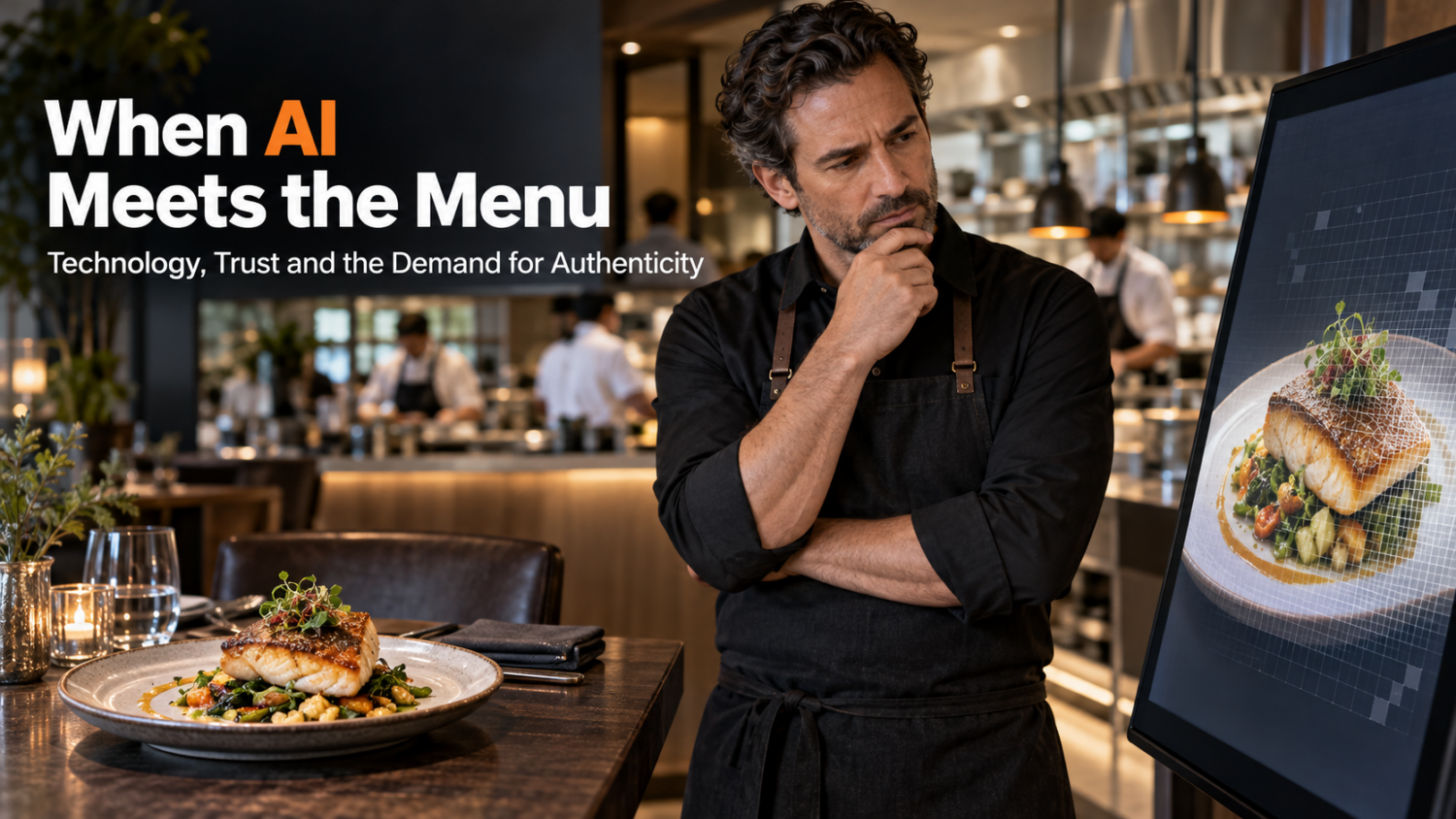
Artificial intelligence is becoming more common in restaurant operations, but diners are not giving it unlimited permission. Recent reporting on AI-generated menu photography has drawn criticism because some synthetic food images appear unrealistic, unappetizing, or disconnected from what a restaurant actually serves. At the same time, current consumer research suggests that many guests are increasingly comfortable with AI when it produces a clear benefit and does not eliminate transparency or access to a person.
The lesson for foodservice operators is not to reject AI. It is to use the technology where it improves the operation without allowing it to weaken the trust on which hospitality depends.
Why AI generated food images are drawing criticism
Restaurants have an understandable reason to experiment with generated imagery. Professional food photography can be expensive, menus change quickly, and digital ordering platforms create a constant demand for fresh visual content. An AI image can be produced faster and at a lower upfront cost than a traditional photo shoot.
The problem begins when the image no longer functions as decoration and starts acting as a promise. A menu photograph tells a guest what a dish looks like, how it is portioned, and what they should expect to receive. If the pictured food was never prepared by the restaurant, the image may create expectations the kitchen cannot reliably meet. Even when there is no intent to deceive, an overly polished or physically implausible image can make customers question what else is artificial.
Recent coverage from The Guardian and WIRED described public criticism of synthetic menu and storefront images, including food with distorted textures or details that viewers found unsettling. Those examples do not prove that every diner rejects every generated image. They do show that food imagery is unusually sensitive because appetite depends on familiarity, texture, and trust.
Consumers are open to AI on specific terms
A 2026 consumer survey commissioned by restaurant technology company PAR Technology offers useful context. The online survey of 1,000 U.S. adults, fielded through Dynata in June 2026, found that 48% of respondents were comfortable with AI making operational decisions such as adjusting labor to demand or optimizing menus based on inventory. The survey also reported that 51% were comfortable with AI being used to improve service consistency and shorten wait times.
Acceptance had boundaries. In the same survey, 43% ranked transparency as the most important factor in trusting a restaurant's use of AI. 47% said AI goes too far when it replaces most human interaction, while 44% said it goes too far when they cannot easily reach a person. Because the research was commissioned by a restaurant technology provider, operators should treat it as one current consumer survey rather than a universal prediction. Still, the direction is practical: customers appear more receptive when the benefit is visible, the use is understandable, and human help remains available.
Where AI can provide practical value
The strongest restaurant applications may be the ones guests barely notice. The National Restaurant Association identifies several operational uses for AI, including labor scheduling, forecasting food and supply purchases, responding to routine questions, analyzing business data, and supporting marketing work. These tools can reduce repetitive administrative tasks and help managers act on information already produced by their restaurants. This is different from asking AI to imitate the meal itself. Forecasting tomorrow's ingredient needs does not change the guest's understanding of what is being sold. A fabricated photograph can. That distinction provides a useful operating principle: the closer an AI use comes to making a claim about the food, the price, or the service, the more carefully it should be reviewed.
A practical standard for restaurant operators
Before adopting an AI tool or publishing AI-assisted content, operators can ask five straightforward questions.
- What problem does this solve. Start with a defined operational or guest-service need rather than adding technology because it is fashionable.
- Could it misrepresent the experience. If an image, description, offer, or recommendation could create a false expectation, require human review before publication.
- Would a guest reasonably want disclosure. Transparency matters most when AI directly shapes what a customer sees, pays, orders, or believes about the restaurant.
- Can someone reach a person. Automation should provide an efficient path to human assistance when the tool cannot resolve a request.
- Can the result be measured. Track whether the tool improves wait times, accuracy, waste, labor efficiency, sales, or another defined outcome.
Authenticity is becoming more valuable
AI can make restaurant operations faster and more informed. It can help organize data, reduce repetitive work, and improve consistency. But hospitality is not only an efficiency problem. Guests also respond to real food, recognizable people, and a sense that the experience was created with care.
That may be why the backlash against artificial food photography matters beyond a few unattractive images. It is a reminder that restaurants sell confidence as well as convenience. Operators do not need to choose between technology and authenticity, but they do need to know which one the customer is expecting in each moment. The most durable strategy is simple: use AI to support the work, disclose it when the context calls for transparency, verify every customer-facing claim, and preserve the human judgment that turns a transaction into hospitality.