
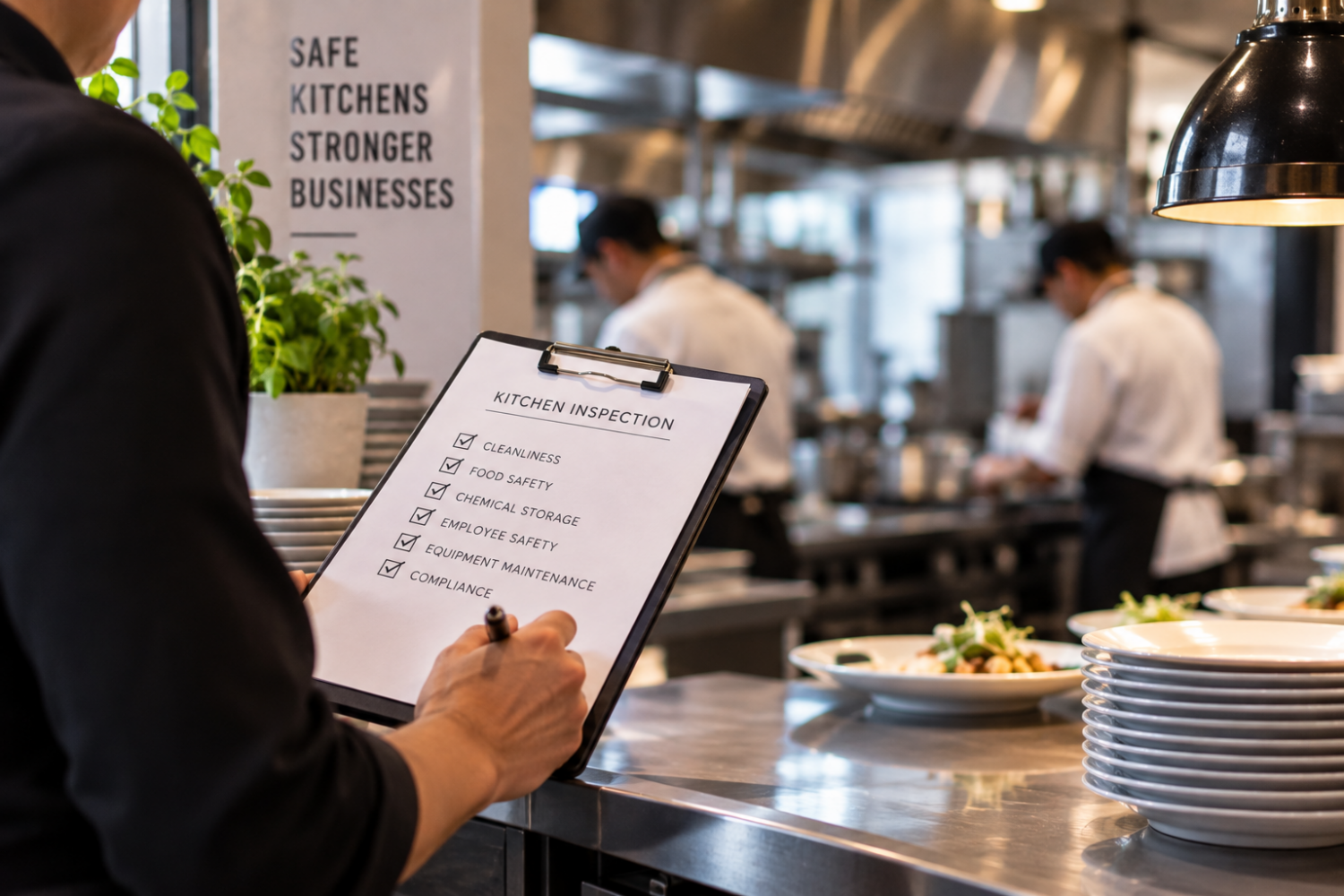
A commercial kitchen can look clean and still have problems hiding in plain sight.
Grease accumulating on equipment, cookware that never quite gets back to clean, improperly handled cleaning chemicals, or a cleaning task that has gradually disappeared from the schedule can all become bigger issues than they initially appear.
For restaurant operators, cleaning is not simply about appearance. It intersects with food safety, employee safety, equipment condition, and regulatory compliance.
Here are five areas worth paying attention to.
1. “It Gets Cleaned Regularly” Isn't Specific Enough
One of the easiest ways for cleaning tasks to fall through the cracks is to rely on an informal understanding of what gets cleaned and when.
The FDA Food Code provides specific requirements for certain equipment and surfaces. For example, food contact surfaces of cooking and baking equipment generally must be cleaned at least every 24 hours, while nonfood contact surfaces must be cleaned frequently enough to prevent the accumulation of soil residue.
Not every surface or piece of equipment has the same required cleaning frequency, and state and local requirements can differ because the FDA Food Code itself is a model code that jurisdictions use when developing their own regulations.
The practical takeaway is simple: define the task, define the frequency, and define who is responsible for it.
A written cleaning schedule is much easier to manage than “we clean that when it needs it.”
2. Cleaning and Sanitizing Are Not the Same Thing
These terms are often used interchangeably in everyday conversation, but from a food safety perspective, they are different processes.
Cleaning removes food residue, grease, and other soil from a surface. Sanitizing comes afterward and reduces microorganisms to appropriate levels.
The distinction matters because sanitizing a surface that hasn't first been properly cleaned can undermine the effectiveness of the sanitizing step. The FDA Food Code requires food contact surfaces and utensils to be sanitized after cleaning and before use.
That means a surface looking clean isn't necessarily the end of the process.
Restaurant teams should understand which equipment requires cleaning only and which food contact items must subsequently go through the appropriate sanitizing process.
3. Chemical Safety Deserves More Attention
Cleaning chemicals are so common in restaurants that it's easy to forget they are still chemicals.
OSHA specifically identifies restaurant cleanup as an area where employees may be exposed to hazardous cleaning products. Where hazardous chemicals are used, OSHA's Hazard Communication requirements include employee training, appropriate labels, and access to Safety Data Sheets. Depending on the chemicals involved, appropriate personal protective equipment may also be required.
Employees should know what they're using, how it should be diluted or handled, what protective equipment is required, and what should never be mixed.
One particularly important example is chlorine bleach and ammonia. OSHA warns against mixing them because the reaction can release dangerous gas.
Safety Data Sheets shouldn't simply exist in a binder somewhere. Employees who work with the products should know where the information is and understand the precautions relevant to their jobs.
4. Don't Let Buildup Become “Normal”
This is one of the most common operational traps in a busy kitchen.
A pan gradually darkens. A rack becomes increasingly coated. Grease accumulates around equipment. Each individual change happens slowly enough that nobody considers it unusual.
Eventually, the condition simply becomes accepted as what the equipment looks like.
The FDA Food Code addresses this directly for nonfood contact equipment surfaces, requiring them to be cleaned frequently enough to prevent soil residue from accumulating.
Restaurant operators can benefit from periodically looking at their kitchens with fresh eyes.
Ask a simple question:
If this were brand new equipment, would we consider its current condition acceptable?
That question can reveal cleaning and maintenance issues that a team has stopped noticing.
5. The Cleaning Process Itself Shouldn't Create Another Safety Problem
Getting something clean is only half of the equation. How employees get it clean matters too.
Repeated exposure to caustic cleaners, splashing chemicals, manually handling sharp objects, and performing physically demanding cleaning tasks can create risks of their own.
OSHA recommends measures including appropriate gloves and other PPE when necessary, employee training, proper chemical handling, and reducing employee contact with cleaning chemicals where feasible.
When evaluating a cleaning process, operators should therefore ask two questions:
Is the process actually getting the equipment clean?
Is it a safe and reasonable way for employees to do the job?
A process that solves the first problem while unnecessarily creating the second deserves another look.
Compliance Is Easier When Good Cleaning Becomes Routine
The strongest commercial kitchen cleaning programs aren't built around preparing for the next inspection.
They're built around consistency.
Employees know what needs to be cleaned. They know when it needs to happen. They have the correct tools and chemicals. They understand the safety procedures. Management can verify that the work is actually being completed.
When those systems are part of everyday operations, compliance becomes less of an event and more of a result.
And in a restaurant, that's ultimately the goal: a kitchen that is clean, safe, and ready for service every day, not just when someone is coming to inspect it.