
Restaurant labor costs have climbed to some of the highest levels the industry has tracked. The National Restaurant Association's most recent operations data shows the average restaurant's labor costs surpassing 36.5% of revenue, and minimum wage increases across 22 states in 2026 are pushing that number higher still.
Cutting staff isn't a real option for most operators. Guests still expect fast service and food that comes out right the first time. The more realistic path is reducing how many hours a task takes rather than how many people are on the schedule, and that's exactly what automation is built to do.
Most conversations about restaurant automation focus on the front of house or the cook line: ordering kiosks, kitchen display systems, robotic fryers. Far fewer focus on the back of house task that eats hours every day without anyone questioning it: cleaning the equipment that made service possible in the first place. For those who want to learn how to lower restaurant labor costs using automation, warewashing is an untapped opportunity that can yield real savings.
Why Are Labor Costs Under So Much Pressure In Restaurants?
Prime cost, the combination of food cost and labor cost, is the number every restaurant operator watches closely, and labor is the half of that equation that keeps climbing. Turnover in back of house roles stays high across the industry, and a restaurant running labor above 38–40% of revenue is usually dealing with a structural problem rather than a slow week.
That structural problem tends to trace back to hours lost on repetitive manual tasks, the kind that don't require a skilled line cook but still take up a real share of payroll.
"We hear the same thing from operators every week," says Kelly Gavson, Director of Finance of Hyginix. "Nobody budgets time for scrubbing. It just quietly happens anyway, shift after shift."
How To Lower Restaurant Labor Costs Using Automation: Where Operators Are Starting
Restaurants working out how to lower restaurant labor costs using automation usually start in a few familiar places:
- Scheduling and forecasting software aligns staff hours to actual demand instead of a manager's best guess.
- Kitchen display systems replace paper tickets on the line and cut down on miscommunication during a rush.
- Inventory platforms track usage automatically and trigger reorders before anyone has to count shelves by hand.
- Digital cleaning checklists and food safety logs reduce the time managers spend walking the building to sign off on tasks in person.
Each of these tools frees up hours somewhere in the building. What most of them miss is the hours spent scrubbing.
The Restaurant Cleaning Task Automation Keeps Skipping: Warewashing
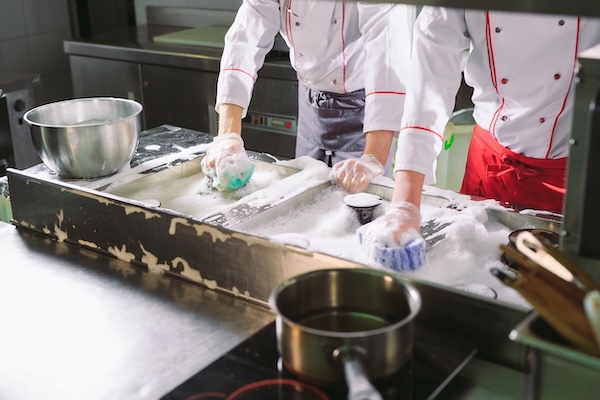
In a typical commercial kitchen, pots, pans, hood filters, and fry baskets get cleaned by hand in the three-compartment sink. That water cools fast under a busy kitchen's demands, so staff end up draining and refilling it every 1–2 hours on top of the scrubbing itself. Heavy carbon buildup on baking sheets and fryer baskets takes even longer to work off, and it's often the reason kitchens end up throwing away equipment that could otherwise last for years.
That scrubbing time adds up across a stewarding shift, and it's exactly the kind of repetitive, physically demanding work behind so much of the turnover in back of house roles.
Using A Heated Soak Tank To Lower Restaurant Labor Costs
The FOG Tank® is a heated soak tank built to take restaurant equipment cleaning off your staff's plate. It runs on a proprietary, non-caustic, non-toxic cleaner called Tiger Carbon Removal Powder, and it cleans cookware and kitchen equipment made of metal as well as heavy-duty plastic.
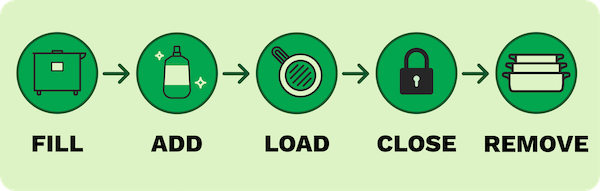
The process for using the FOG Tank only takes 5 simple steps:
- Fill the FOG Tank with water (preferably hot) to the marked fill line and turn it on.
- Add the Tiger Carbon Removal Powder.
- Load dirty pots, pans, hood filters, fry baskets, or other metal or heavy-duty plastic items into the tank using the built-in lifting basket.
- Close the lid and walk away while the tank soaks the cookware and equipment.
- Remove the fully cleaned and sanitized items, rinsing off any loosened residue.
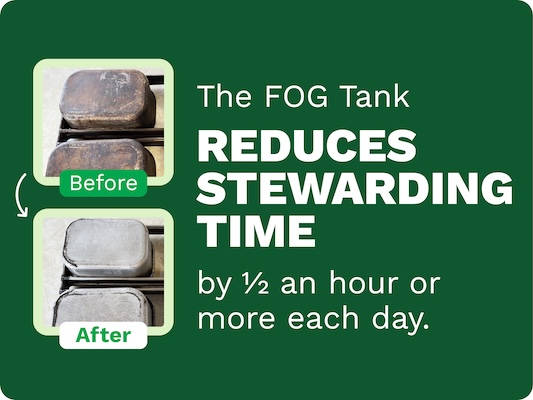
That "close the lid and walk away" step is the automation. Nobody stands over the FOG Tank scrubbing. A single FOG Tank can cut stewarding labor by half an hour or more each day. Not only that, but the water and Tiger Carbon Removal Powder last a full month before they need to be changed, no matter how often you run the FOG Tank. That means staff aren't spending time refilling a sink every couple of hours either.
"I strongly endorse the FOG tank. Since introducing this equipment, we have realized significant labor savings along with enhanced appearance for customer facing product merchandising!" — Dave Grimes, Huck's Convenience Stores
Manual Cleaning vs. The FOG Tank®
To take full advantage of the FOG Tank® to lower restaurant labor costs, consider how automating warewashing can save on not just labor costs, but also water usage, cleaning chemicals, and energy bills compared to manual scrubbing.
Three-Compartment Sink (Manual) | The FOG Tank (Automated) | |
Water and chemical refills | Every 1 to 2 hours | Once a month |
Staff attention required | Continuous scrubbing | Load, close the lid, and walk away |
Daily labor impact | Varies by kitchen and volume | Half an hour or more saved per day, per tank |
Can The FOG Tank® Replace Your Three-Compartment Sink?
The FOG Tank® is designed to do everything your three-compartment sink does, only better. The more you use your FOG Tank over your three-compartment sink, the more time and money you can save. However, health codes still require commercial kitchens to have a three-compartment sink available. While this means you can’t get rid of your sink, there are no rules requiring you to actually use it.
Also, the FOG Tank is built to clean equipment, cookware, and dishes your team can remove and carry, not for fixed ductwork or hood structures attached to the building. Cleaning those still requires a certified contractor under NFPA 96. Knowing that distinction upfront helps restaurant operators assign cleaning responsibilities correctly and stay compliant.
Is The FOG Tank® Just For Heavy Carbon Buildup?
Some restaurant operators hear about the FOG Tank® and assume it only makes sense once carbon has built up badly on a pan or hood filter. The good news is the FOG Tank is built for daily use, not just the extreme cases. Running it every day on ordinary grease and grime prevents that kind of heavy buildup from forming in the first place, allowing you to take advantage of steady, everyday savings on labor, water, and energy.
Use GrimeGo® For Daily Cleaning Beyond The Tank
Not everything in a kitchen goes into a soak tank. GrimeGo® is a non-caustic, non-toxic, all-purpose cleaner built for the surfaces that don't go in a tank, such as oven interiors, floors, and mats. Running the FOG Tank® for dishes, cookware, and equipment and using GrimeGo® for surfaces gives a commercial kitchen a cleaning routine that covers nearly everything needed without adding labor hours back in as you figure out how to lower restaurant labor costs using automation.
The FOG Tank® Is Built To Scale Automation and Savings Across Restaurant Locations
For franchise owners and multi-unit restaurant operators, the same half hour a day adds up differently at every location, and standardizing the process makes it easier to compare labor performance across the group rather than leaving cleaning up to whatever each kitchen has always done.
"Northland Properties Corporation, Denny's restaurants, operates 56 restaurants in Canada, and all our restaurants have FOG Tanks from Hyginix. Our staff loves the tank as it is a compact tank and provides an excellent cleaning solution to our hood filters in specific and many other pots and pans. We recommend the use of FOG Tank to one and all the restaurants to save the labor for cleaning and get excellent cleaning results." — Rakesh Nanda, Northland Properties Corporation (Denny's)
Calculate Your Own Restaurant Labor Savings Today
Industry averages are a starting point, not the number that matters most to your business. A more useful exercise is looking at your own stewarding hours as you consider how to lower restaurant labor costs using automation.
For example, if 2 stewards each spend 45 minutes a day scrubbing pans and hood filters across a 6-day work week, that's 9 hours of labor going toward one task alone. Compare that to half an hour or more saved per day, per FOG Tank®, and the math tends to make the case on its own.
If you want help running those numbers for your specific kitchen, our team can walk through it with you.
Lowering restaurant labor costs with automation doesn't have to mean robots on the line. Sometimes it means removing one repetitive task, quietly and consistently, every single day.
See what other operators are saying about the FOG Tank on our testimonials page, or contact us now to speak with one of our experts or order yours today.