
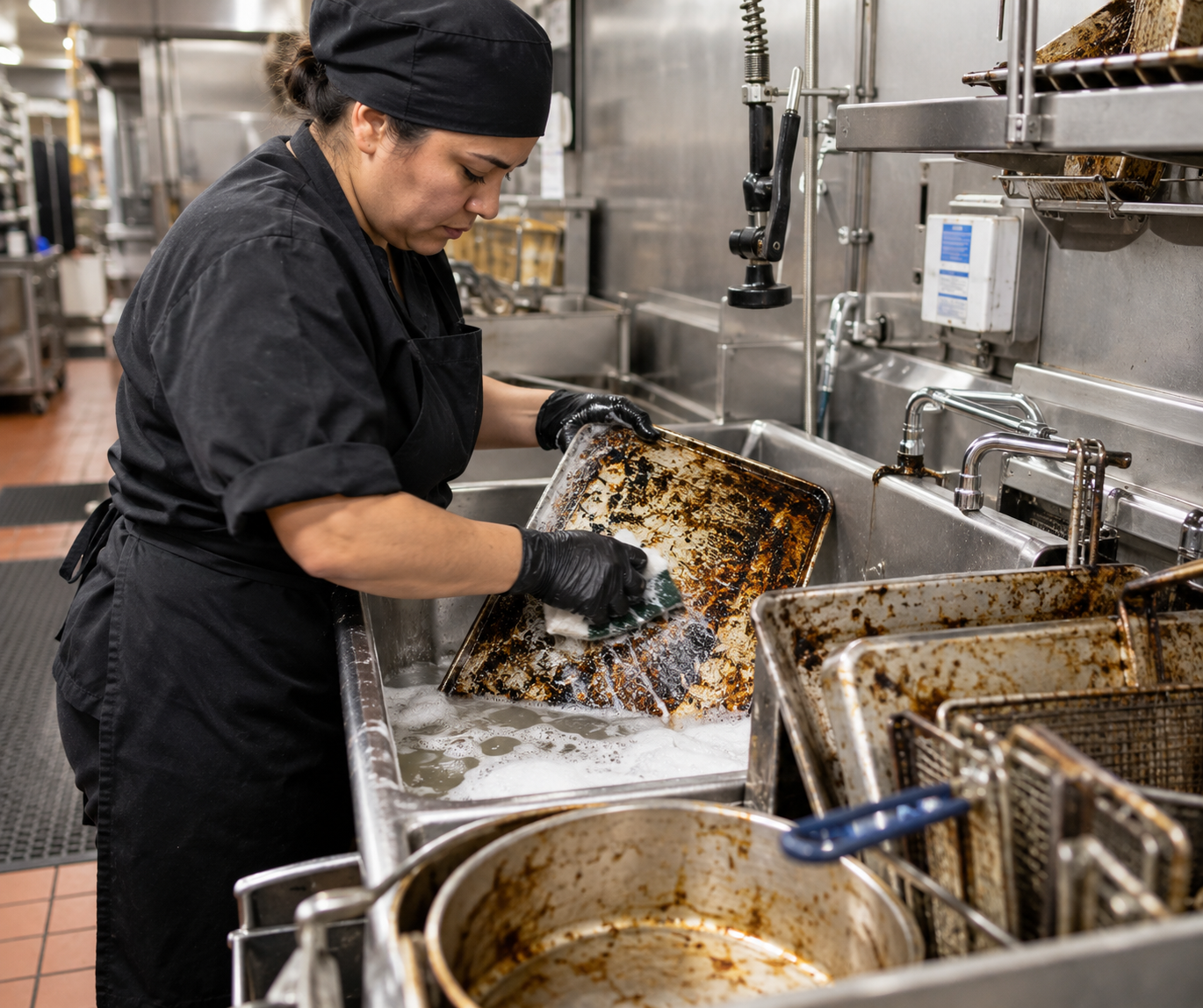
Labor isn't a minor expense in the restaurant business. According to the National Restaurant Association's latest Restaurant Operations Data Abstract, salaries and wages, including benefits, represented a median 36.5% of sales for full-service restaurants and 31.7% for limited-service restaurants among survey respondents. When labor consumes that much of every sales dollar, even small repetitive tasks are worth examining.
One of those tasks may be hiding at the three-compartment sink.
Cleaning hood filters, fryer baskets, sheet pans, pots, pans, grates and other heavily soiled equipment is simply part of operating a commercial kitchen. But the traditional approach: soaking, scraping and scrubbing can consume valuable employee time day after day.
For operators looking to control labor costs without compromising cleanliness, it may be time to stop asking only how employees should clean and ask a different question:
Does all of this work need to be done manually?
The Real Cost of Scrubbing is Easy to Overlook
The cost of manual equipment cleaning doesn't normally appear as its own line item on a restaurant's P&L. It's buried inside payroll. Consider a hypothetical restaurant where employees collectively spend 45 minutes each day manually scrubbing heavily soiled kitchen equipment. Over 30 days, that's 22.5 labor hours devoted to a single repetitive task. At an illustrative loaded labor cost of $20 per hour, that's $450 of employee time each month, or $5,400 per year.
And that's just one location.
The actual numbers will differ significantly from one operation to another depending on wages, equipment volume, cleaning procedures and the amount of manual cleaning required. The point isn't that every restaurant spends $5,400 per year scrubbing equipment.
It's that small amounts of repetitive labor become meaningful when multiplied across hundreds of operating days and potentially dozens or hundreds of locations.
What Else Could Employees Be Doing?
There's also an opportunity cost to manual cleaning. Time spent standing at a sink scrubbing equipment can't simultaneously be spent on food preparation, restocking, closing procedures, receiving deliveries, cleaning other areas of the restaurant or completing other operational tasks. This is particularly important for multi-location restaurant operators.
Saving even a relatively small amount of time at each restaurant can become significant when the same process is repeated across an entire system. That's why equipment cleaning shouldn't be viewed exclusively as a sanitation issue.
It's also a labor-allocation issue.
Why Traditional Soaking Can Still Require Hands-On Work
Putting heavily soiled equipment into a sink doesn't necessarily eliminate the work. Carbonized and greasy equipment may still need to be soaked, scraped or scrubbed, rinsed and inspected before being returned to service. The more stubborn the buildup, the more employee attention the process can require. There is another challenge: consistency. One employee may spend considerable time cleaning an item thoroughly. Another may have less time available during a busy shift. When a cleaning process depends heavily on manual effort, the amount of labor required can vary from employee to employee and shift to shift.
What if the Cleaning Could Happen in the Background?
A heated soak tank changes the workflow. Instead of requiring an employee to continuously scrub equipment, removable kitchen equipment is placed into a heated cleaning solution and allowed to soak. While the equipment is soaking, the employee can move on to another task. The FOG Tank® heated soak tank operates at approximately 185°F and is designed to remove accumulated fats, oils, grease and carbon from compatible commercial kitchen equipment while minimizing the need for manual scrubbing. Depending on the item and level of buildup, equipment can soak for a relatively short period or remain in the tank for several hours or overnight.
The process becomes simple:
Load it. Let it soak. Remove it. Rinse it.
The hours in between don't require an employee standing over a sink continuously scrubbing.
Small Time Savings Become Big Numbers Across Multiple Locations
For multi-unit operators, the scale is where the economics become particularly interesting. Consider another purely illustrative example. If a restaurant could eliminate just 20 minutes of manual equipment-cleaning time per day, across 100 locations that would represent approximately:
12,167 labor hours per year.
At an illustrative loaded labor rate of $20 per hour, that employee time would represent approximately:
$243,000 annually.
This example demonstrates why multi-unit operators should measure repetitive tasks in minutes per location per day. Twenty minutes doesn't sound particularly important. Twenty minutes × 365 days × 100 restaurants looks very different.
Calculate the Cost Using Your Own Numbers
You don't need an industry average to determine whether manual equipment cleaning represents a meaningful opportunity in your operation. Measure it. For one week, track the actual amount of employee time spent soaking, scraping and manually scrubbing heavily soiled equipment.
Then calculate:
Daily Manual Cleaning Hours × Loaded Hourly Labor Cost × Operating Days × Number of Locations
For example:
0.75 hours × $20 × 365 days × 25 locations = $136,875
That doesn't automatically mean all $136,875 can be eliminated. Employees still need to load, unload and rinse equipment, and recovered time only creates financial value if the operation can productively reallocate or reduce those labor hours.
But it gives management something far more useful than a marketing claim: their own number.
The Cost of Cleaning Is More Than the Purchase Price of Cleaning Equipment
When evaluating a commercial kitchen cleaning process, the acquisition price of the equipment is only one consideration.
Operators should also consider:
Employee time required
Frequency of cleaning
Water usage
Cleaning chemical requirements
Energy usage
Maintenance requirements
Equipment capacity
Expected service life
Warranty and support
Ability to standardize the process across multiple locations
That provides a more meaningful comparison of total operating cost.
For operators evaluating the broader cleaning process, our Kitchen Equipment Decarbonization FAQs answer common questions about heated soaking, equipment compatibility, operating costs, safety and commercial kitchen applications.
Automation Doesn't Have to Mean Robots
Restaurant automation often brings to mind ordering kiosks, kitchen display systems, scheduling software or even robotics. But automation doesn't necessarily need to be complicated. If a repetitive process that previously required continuous employee attention can instead occur largely in the background, part of that process has effectively been automated. That's what a heated soak tank can accomplish for compatible commercial kitchen equipment. An employee still loads the equipment. An employee still removes and rinses it. But the soaking process itself doesn't require someone to stand there scrubbing for the duration. For restaurant operators trying to improve productivity, sometimes the most practical automation isn't a robot. It's removing one repetitive manual task from the shift.
For more on this topic, read How to Lower Restaurant Labor Costs Using Automation: Bring in a Heated Soak Tank.
Built for Commercial Kitchens for More Than 30 Years
FOG Tank® is the original heated soak tank for commercial kitchens, originating with the invention of the category more than 30 years ago. Today, FOG Tanks serve thousands of commercial kitchens across all 50 states and worldwide. And longevity matters when calculating ROI. Hyginix still has FOG Tanks operating in commercial kitchens after more than 20 years in service. That means operators evaluating a heated soak tank shouldn't ask only:
“How much does it cost?”
They should also ask:
“How long will it last, how much employee time will it require, and what will it cost me to operate over its useful life?”
Learn more about FOG Tank's history, operation and common applications in our Kitchen Equipment Decarbonization FAQs.
See What it Does in Your Own Kitchen
ROI calculations are useful.
Actual results are better.
That's why FOG Tank offers operators the opportunity to test a FOG Tank in their own commercial kitchen for seven days. Put your own hood filters, fryer baskets, pots, pans, grates and other compatible equipment into the tank. Use your actual employees. Measure your actual cleaning time. And compare the process with what your team is doing today.
Don't compare claims. Compare results.