
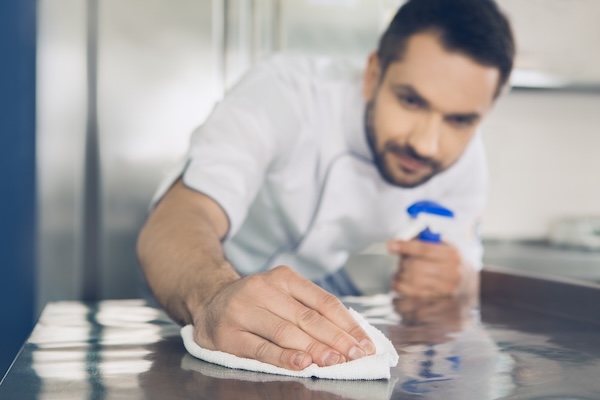
A kitchen can look clean and still be dirty in the places that matter most. Wiping counters and mopping floors takes care of what customers and health inspectors see on a walk through, but grease and carbon don’t stop building up behind that clean-looking surface. Learning how to remove built-up grime during deep cleaning in your kitchen means understanding what a daily wipe down actually accomplishes and what it does not, and knowing which tools, techniques, and equipment pull grime out of the places it hides.
We’ll walk you through why grime keeps returning even in kitchens that clean every day, the steps to getting a deep clean done right, and where equipment like The FOG Tank® (a heated soak tank for commercial kitchens) fits into the routine for your toughest carbon buildup.
Table of Contents:
- Why Grime Keeps Coming Back
- Daily Cleaning vs. Deep Cleaning
- 5 Steps To Remove Built-Up Grime
- How To Handle Hood Filters and Grease Traps
- A Realistic Deep Cleaning Schedule
- Common Mistakes That Leave Grime Behind
- Frequently Asked Questions
- How Hyginix Products Can Help
- Remove Built-Up Grime Today
Why Grime Keeps Coming Back Even When You Clean Your Kitchen Every Day
Heat and moisture during service push grease back onto surfaces that were wiped down hours earlier. Splatter from cooking settles on walls, equipment sides, and other vertical surfaces that rarely get a second look. That’s one reason a kitchen can feel like it’s fighting a losing battle trying to remove built-up grime. Daily cleaning controls what is visible in the moment, but it doesn’t remove what has already worked its way into seams, filters, and corners that are easy to miss.
It also helps to separate degreasing, cleaning, and sanitizing into three different jobs instead of one wipe that is supposed to cover everything.
- Degreasing breaks grease down.
- Cleaning removes dirt, debris, and grease from the surface.
- Sanitizing takes care of any germs left behind.
Skip a step, or do them out of order, and residue stays behind, ready to attract more grime as soon as the kitchen heats back up.
Daily Cleaning vs. Deep Cleaning: Where Built-Up Grime Actually Lives
Daily cleaning covers what is visible: countertops, spills, cooking surfaces, and floors. Deep cleaning covers what daily cleaning cannot reach, and it needs to happen on a regular schedule rather than only when something looks visibly dirty. That schedule should get tighter for high-volume kitchens, since more cooking hours mean more grease working its way into places a towel never touches.
Built-up grime tends to collect in a handful of predictable spots:
- Hood filters and the ductwork behind them
- Equipment backs, undersides, and legs
- Floor edges, corners, and grout lines
- Fryer interiors, oven interiors, and other enclosed cooking equipment
None of these show up on a quick visual check, which is exactly why they carry the most buildup by the time a deep clean rolls around.
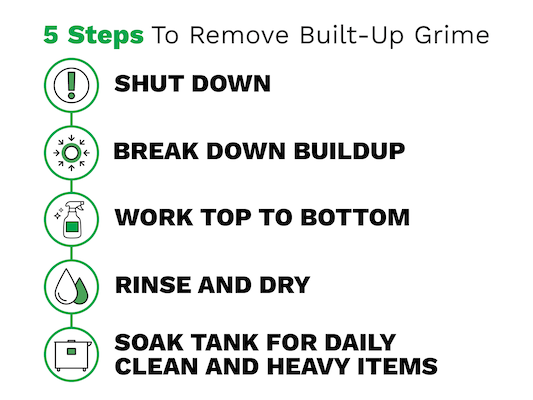
5 Steps To Remove Built-Up Grime From Kitchen Equipment
By following these 5 steps to remove built-up grime during deep cleaning on a regular schedule, you can ensure a consistent cleaning process that keeps your commercial kitchen sanitary and compliant.
1. Shut Down And Stage First
Power down and unplug equipment, and let anything hot cool completely before starting to clean. Set up separate zones for clean and dirty items so grime that has already been removed does not end up back on a surface you just finished. Stage your tools, degreaser, and protective equipment ahead of time so the process does not stall halfway through.
2. Break Down Heavy Buildup Before Wiping
Baked-on carbon won’t come off with a simple wipe, so start there.
- A heated soak tank can clean and sanitize hood filters, sheet pans, fry baskets, and other removable metal cookware.
- A scraper handles carbonized buildup on fixed surfaces, such as griddle tops, flat top ranges, worktables, prep counters, oven interiors, and floors. A degreaser suited to the level of soil can help break down the buildup, but will need a few minutes to sit first before you touch it with a scraper.
- Nylon brushes work into seams, edges, and textured areas of fixed surfaces that a flat scraper or cloth cannot reach.
3. Work Top To Bottom
Start with the highest surfaces in the space, such as shelves and upper walls. Then move down to equipment fronts and countertops. End with the floor. Cleaning in the wrong order just means grime you already removed falls back onto a surface you finished cleaning.
4. Rinse And Dry Completely
Standing moisture is what pulls grime back onto a surface that looked clean a minute ago, so drying is not an optional last step. Go back over floor edges, equipment undersides, and anywhere water tends to pool, and make sure nothing is left damp when you are done.
In our experience, the single most common (and most avoidable) mistake in this whole sequence is skipping the second rinse pass. It takes seconds, but it often gets skipped anyway because the surface already looks clean by that point.
5. Let A Soak Tank Handle The Heaviest Buildup
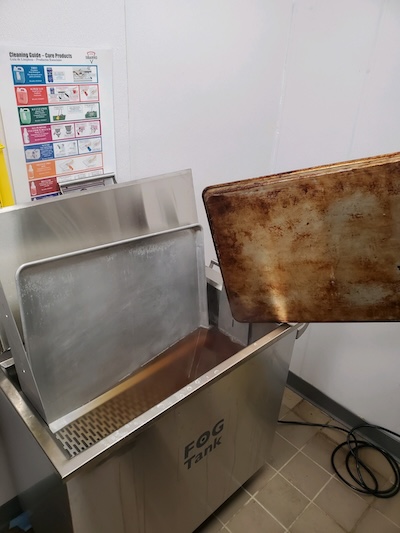
Some items are not worth scrubbing by hand no matter how much time you spend on them. Hood filters, fry baskets, and sheet pans with baked-on carbon are the usual offenders, and they are exactly what a heated soak tank is built for.
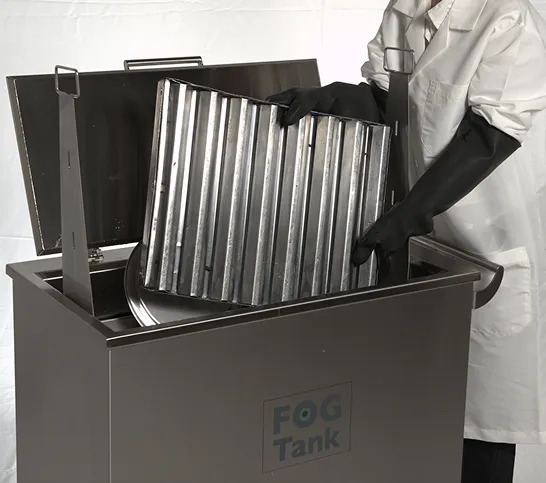
The FOG Tank® is a heated soak tank that removes fat, oil, grease, and carbon buildup from metal and heavy-duty plastic kitchen equipment without scrubbing. It cleans everything from your usual dishes and utensils to the items your staff struggle to clean in the sink.
Instead of measuring out chemicals and replacing water for every load, you fill the tank with water and our Tiger Carbon Removal Powder once a month. From there, the process is simple: load your dirty kitchenware and equipment into the tank, close the lid, and walk away. Items come out clean and sanitized, and the tank keeps working on the next load without needing to be refilled again until the following month.
While you’re still legally required to keep your three-compartment sink, you’ll never need to use it. The FOG Tank more effectively handles the items your sink and dish machine struggle to get all the way clean, while also covering daily warewashing with less labor and water.
"We got the FOG Tank because it’s our goal to keep the Chef’s pots and pans looking presentable for years to come, while not putting the wear and tear the continuous scrubbing brings on the equipment. The FOG Tank® reduces labor by eliminating the need to scrub carbon buildup and baked-on oil. There’s no need to continuously empty and fill the FOG Tank, which is our favorite feature." — Keith McDonald, Executive Steward, Hilton – San Diego Bayfront
Special Focus: Hood Filters And Grease Traps
Hood filters deserve their own section in a guide on how to remove built-up grime, because they are one of the most fire-prone areas in any commercial kitchen. NFPA 96, the fire safety standard that governs commercial cooking ventilation, sets cleaning intervals that scale with cooking volume and fuel type. Kitchens running high volume or continuous cooking are expected to clean more often than kitchens with lighter, seasonal use, and local fire authorities can require more frequent services on top of that baseline.
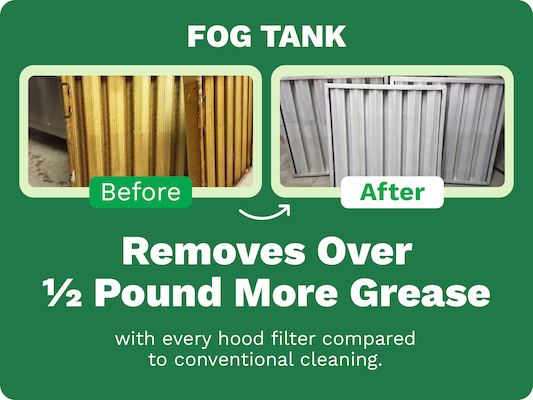
The reason this matters is that grease-clogged filters and ducts do more than look bad. They reduce airflow and raise fire risk, which is why exhaust systems get treated as their own category of cleaning rather than folded into general equipment maintenance. It is also why filters that look serviceable from the front are often carrying more buildup than expected. Hood filters that go through a cycle in the FOG Tank® come out roughly half a pound lighter on average, which gives a sense of how much grime a filter can hold onto even when it still passes a quick glance.
A Realistic Deep Cleaning Schedule for Commercial Kitchens
A workable schedule for deep cleaning your commercial kitchen doesn’t need to be complicated. Following a simple schedule like the one below can make it easier for staff to keep track of daily and deep cleaning tasks on a reliable cadence and ensure they remove built-up grime during deep cleaning so nothing slips through the cracks.
Cleaning Frequency | Cleaning Tasks |
Daily | Sweep, wipe visible surfaces, empty grease traps, wash dishes and glassware in the sink or dish machine, wash metal and heavy-duty plastic kitchenware in the soak tank |
Weekly | Degrease equipment fronts and floors, flush drains |
Monthly | Run a soak tank cycle for filters and other heavy carbon items, clean refrigeration coils |
Quarterly, or per NFPA 96 and your local fire authority | Full hood and duct service by a qualified provider |
Daily habits make deep cleans faster. They do not replace them.
For operators managing more than one location, standardizing this schedule across every kitchen makes it far easier to spot which location is falling behind, rather than treating each site as its own island with its own routine.
Common Mistakes That Leave Built-Up Grime Behind
A few habits are responsible for most of the grime that survives a deep clean, so keep these in mind when building your commercial kitchen’s processes and staff training:
- Wiping degreaser off without a second rinse pass, which just spreads residue around instead of removing it
- Cleaning from the floor up instead of the ceiling down
- Skipping equipment backs, undersides, and floor edges because they are out of sight
- Letting hood filters go past their service interval because they still look fine from the front
Frequently Asked Questions
Does a soak tank replace my kitchen’s three-compartment sink?
No. You are legally required to have a three-compartment sink as part of your commercial kitchen, though you are not required to ever actually use it if you don’t want to. A heated soak tank can do everything a three-compartment sink can do and more, handling the heavily soiled items that hand washing and dish machines are not built to fully clean.
How often should hood filters be deep cleaned?
It depends on your cooking volume, tasks, and fuel type under NFPA 96, ranging from daily for chargrilling, to monthly for high volume or continuous cooking, to longer intervals for lighter use. Your local fire authority has the final say on what applies to your commercial kitchen.
Are the FOG Tank® and Tiger Carbon Removal Powder safe for aluminum kitchen equipment?
Yes. The FOG Tank® safely cleans and sanitizes heavy-duty plastic and metal items, including aluminum kitchen equipment. The Tiger Carbon Removal Powder used in the tank is non-caustic, non-toxic, and safe for aluminum, along with other types of metal and heavy-duty plastic kitchen equipment.
Will a soak tank work if I only have one or two filters to clean?
Yes. The FOG Tank® is built to run on a monthly cycle regardless of load size, so it works whether you are cleaning a handful of items or a full kitchen's worth.
How Hyginix Products Can Help
Between daily cleaning and a full deep clean, 3 Hyginix products cover most of what a commercial kitchen needs:
- The FOG Tank® handles regular warewashing as well as the heavy carbon and grease buildup on metal equipment that hand scrubbing struggles with.
- Tiger Carbon Removal Powder is the non-caustic, non-toxic cleaner doing the work inside the FOG Tank.
- GrimeGo® is an all-purpose, eco-friendly cleaner and degreaser that covers everything that does not go in the FOG Tank, including floors, mats, and oven interiors.
Remove Built-Up Grime During Deep Cleaning In Your Kitchen Today
Built-up grime is not a scrubbing problem. It’s a sequence problem. Shut down before you start, break buildup down before you wipe, work top to bottom, and dry everything completely. For the removable items that hand cleaning cannot fully tackle, a heated soak tank takes the labor out of the equation entirely.
Contact us now by calling (858) 566-6212 or filling out our form to speak with one of our experts about which Hyginix products fit your commercial kitchen.